Portarlington woman documents history-making ride for research
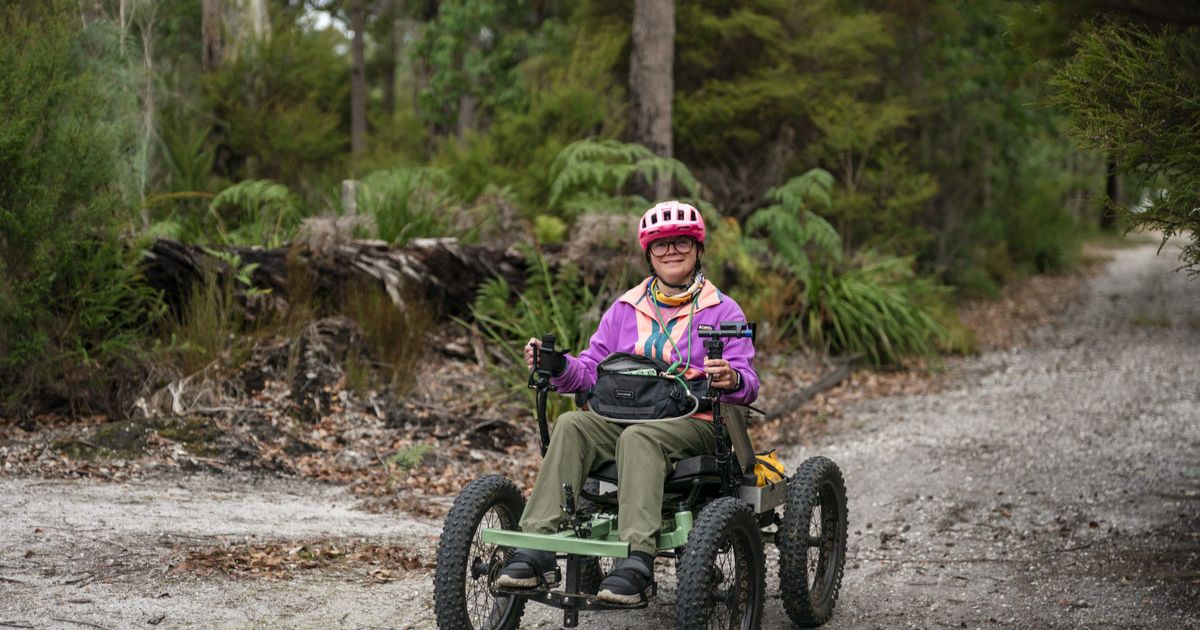
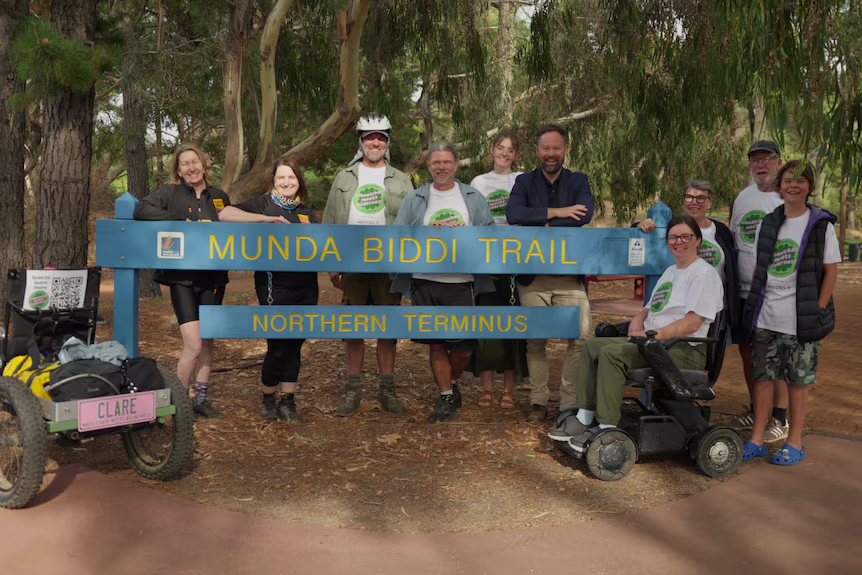
Clare Reilly has become the first person to traverse the Munda Biddi Trail using a wheelchair. Photo: Julia Rau Photography. Clare with her crew ahead of her first official day.


A Portarlington woman has made history as the first person to complete the Munda Biddi Trail in a wheelchair, all while raising essential funds.
Multiple Sclerosis (MS) advocate Clare Reilly has always loved the outdoors.
The former outdoor education teacher has a thirst for adventure and had no interest in allowing her diagnosis to keep her from nature.
After seeing a friend complete the Bicentennial National Trail, Reilly felt inspired to take on a major challenge of her own.
Admittedly feeling a little sorry for herself at the time, she glanced at a vision board she had made 10 months earlier and spotted an image of the Munda Biddi Trail alongside a picture of the ‘Not A Wheelchair Rig’.
“I thought, ‘Nah, we can still do this’,” Reilly said.
One of the world’s longest continuous off-road cycling trails, Reilly said it made sense to her that if it was suited for bikes and their wheels, she could do it in a chair.
While she already used a manual wheelchair at home and a powered wheelchair for errands and trips, neither was suited to a rugged off-road journey.
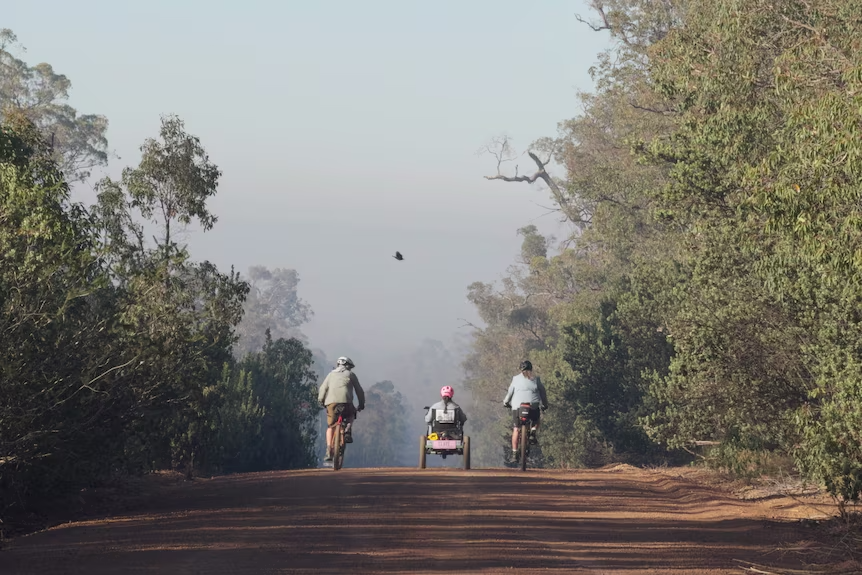
Enter, the Rig: a purpose-built off-road wheelchair powered by a 1,000-watt motor that allows Reilly to head off the beaten track.
“I talk about it in the same way as having multiple pairs of shoes,” she said.
“Going for a run, most people wouldn’t wear their high heels, so if I wanted to go for a big, long cycle, I’m not going to use my around-the-house wheelchair. I’m going to use one that’s made for the job.
“Now I’ve got the Rig and it helps me get out and about and into nature.
“There are so many benefits of getting out in nature and we know that one of the symptoms of disability is poor mental health, so if we can get people out in nature, we know that should have a positive impact.”
The Rig gave Reilly the freedom and confidence she needed to tackle the trail. Sometimes, a little too much confidence.
On the very first day, she took a corner too quickly.
“I came around a corner, probably a bit overconfident and a bit faster than I should,” she said.
“I was already leaning to the left side, and then my front right wheel hit a rock and knocked me over further, and I actually flipped the Rig.
“I hit my face on a rock on the side of the trail, and so on day one – which we weren’t going to tell anyone that we’d done – I ended up with a black eye.”
Initially a shock to overcome, the story became the first of many Reilly documented over her 26-day journey.
Supported by her partner, son, parents, friend and support worker, Reilly said it took a team to accomplish the trail.
“We had a crew of eight and they were just amazing,” she said.
“Something you don’t experience in general is spending a really large amount of time with a small amount of people.
“It was just an insane amount of time together.”
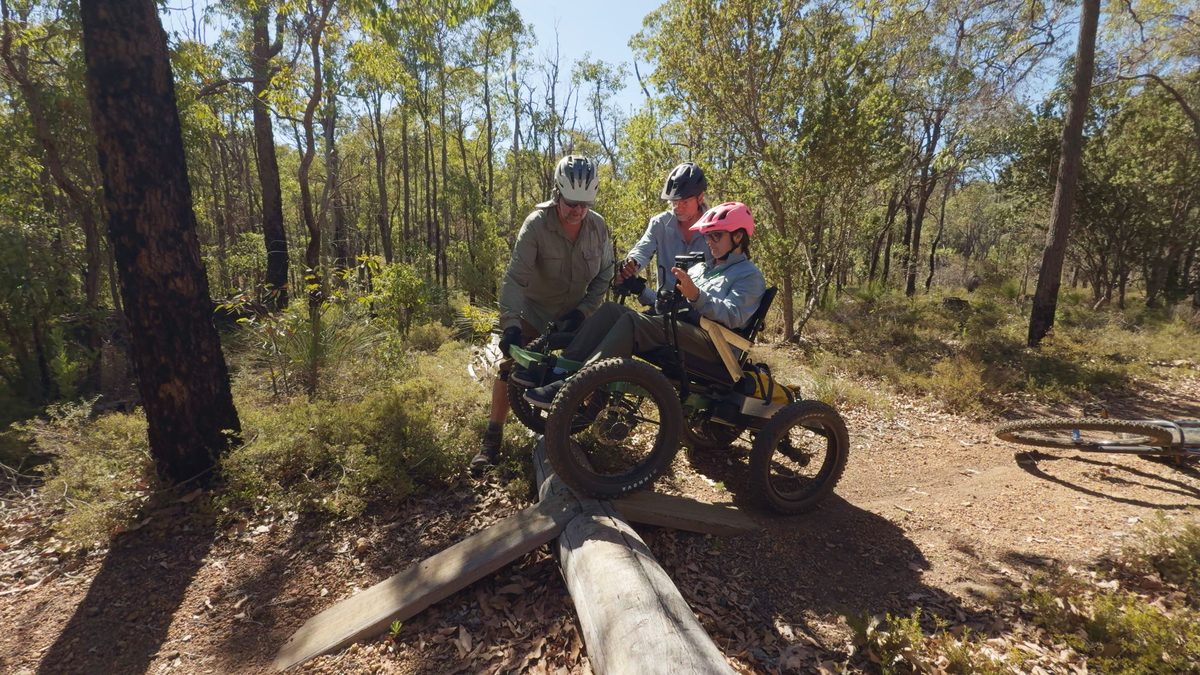
Together they navigated trail obstacles, manoeuvred The Rig across difficult terrain and tackled the logistics of reaching accommodation each night.
But together they made it.
Completing the trail was not only a personal dream for Reilly, but also part of a broader goal to raise $100,000 for the Multiple Sclerosis Research Flagship at University of Tasmania’s Menzies Institute for Medical Research.
With a documentarian following the journey, Reilly said capturing the experience was an important part of building support for the cause.
“I needed something that I could have afterwards that I could either sell or show people to get people on board to continue with helping me fundraise,” Reilly said.
“The documentary is going to be screened at as many different film festivals as we can.
“As for the book, I’ve written more than half. I’m madly trying to get it done.”
It’s a natural continuation of Reilly’s advocacy work, which began with her podcast MS Understood.
Since launching the podcast, she has shared more than 100 stories from people living with or impacted by MS.
Reilly said hearing those experiences had helped her better understand the condition and the many different ways it can affect people.
“Part of it for me was realising that MS can look different, and you can’t expect it’s going to be a certain way,” she said.
Reilly will continue to raise funds and looks forward to the launch of her book and documentary in late 2026.
Further information and donation details are available at wheelchairmeetswilderness.org
Share


Related Articles
Geelong workshop wins top employer award
A Geelong automotive business has been recognised as Victoria and…
Geelong accountant urges taxpayers to avoid costly mistakes as ATO cracks down
TAX time has arrived, and with the Australian Taxation Office…