Mullum Food Co-op unveils expansion
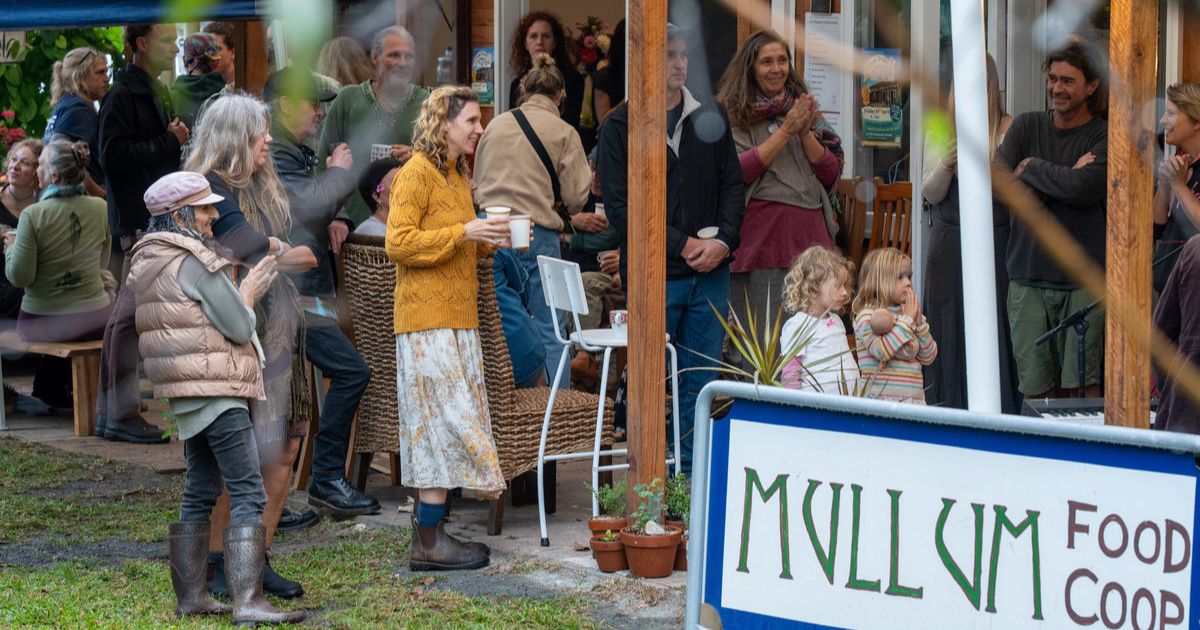
The Mullum Food Co-Op grand opening celebration. Photo: Anton Asche


THE new awning at Mullum Organic Food Co-op came into its own at the organisation’s grand opening last Friday, as attendees took shelter from intermittent downpours.
The upgrade also included an expansion into the site’s larger shed and the addition of an extra container, following months of planning and preparation.
Project coordinator Oriel Paterson said the transformation had long been part of the volunteer committee’s vision.
“Being off-grid in the community garden we’ve had a lot of groundwork to do for optimal food storage conditions,” she said. “We designed with flood resilient materials and principles, for a fully-enclosed structure with a connected insulated and cooled container, volunteer back room and office, a separate cooled stock storage container, and all connected under a large, recycled hardwood front awning.
“It’s been incremental to get to this point. We first opened in a small section of the shed with a roller door, single lightbulb and power point run from a solar panel. Early on we fundraised for an insulated container for more stable food storage conditions. Next, we won a grant for a solar system to allow for cooling and some more lights. In the last half of 2025 we could finally action the grand refit vision.”
The co-op, which has around 300 members, offers a wide range of goods, including nuts, legumes, pasta, rice, seeds, flours, oats, coconut, cacao products, carob, sugars, honeys, syrups, vinegars, oils, salts, cleaning products, spices and tea.
Paterson previously worked at the ANU Food Co-op in Canberra and the Kuranda Arts Co-op, and became involved with the organisation in 2016 when it was based at Kulchajam in Byron Bay’s industrial estate.
It reopened in Mullumbimby’s community garden precinct as Mullum Organic Food Coop in 2017.
“I’ve always been drawn to co-ops for the community aspect of shared care, input and responsibility,” Paterson said. “I value access to quality whole food, dislike packaging and care about the farmers and the planet when it comes to chemical-free farming practices, so being all organic and affordable was an obvious bonus.
“I love that everyone actually owns it and can have input. It’s authentic, ethical, and feeds everyone at bulk prices no matter the size of your kitchen.”
The upgrade was made possible through funding from the NSW and Federal governments through the Growing Regions grant, delivered via Seed Northern Rivers.
Share


Related Articles
Local health, education projects to receive multi-million-dollar injection through state budget
New ambulance stations, expanded maternity services and ongoing flood recovery…
ED and surgical activity remains high as acuity levels rise across Northern NSW hospitals
EMERGENCY departments and surgical theatres across Northern NSW Local Health…