Award-winning image captures gentle art of Cultural burning
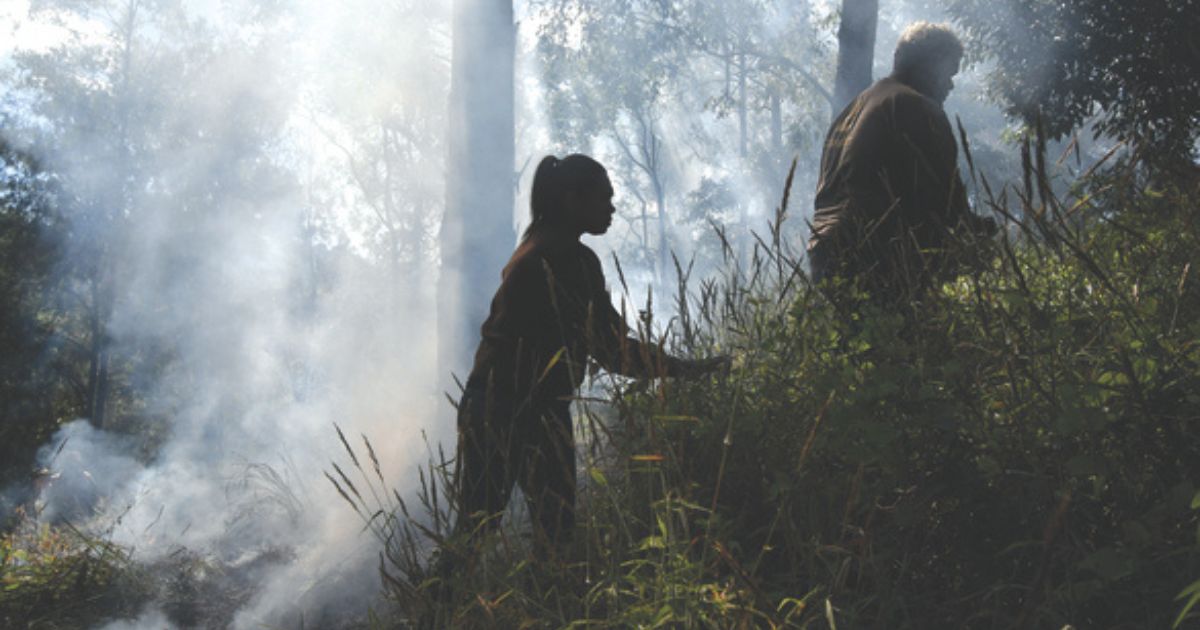
Lockwood's photograph Young Rangers on Country, which was awarded second place in the Healthy Country, Healthy Waters, Healthy Communities Photo & Video Competition. Photo: Michele Lockwood.


SILHOUETTED figures moving through drifting smoke on Bundjalung Country make up the award-winning vision of Northern Rivers photographer Michele Lockwood, who has captured the gentle nature of Cultural burning.
Captured during a Cultural burn in the Lismore region, the photograph features two Aboriginal rangers – cousins who have asked to remain unnamed – quietly guiding fire through the landscape.
The image, titled Young Rangers on Country, was awarded second place in the Healthy Country, Healthy Waters, Healthy Communities Photo & Video Competition, a national initiative run by the National Indigenous Australians Agency (NIAA) celebrating the work of First Nations land and water managers.
The image captures what Lockwood described as the understated nature of Cultural burning and the knowledge systems that underpin it.
“It’s really quite a beautiful process,” she said.
“You’ll see the rangers just grab some dried grass and put it into the flame and then carry that flame and drop it in places that are not really connected to where the fire is and just kind of move the fire gently through the landscape that way.”
Working in her role with Aboriginal-led not-for-profit Jagun Alliance Aboriginal Corporation, Lockwood was on site at Billen Cliffs, a multiple-occupancy property in Larnook, where local Aboriginal rangers carried out the Cultural burn.
Lockwood said she took dozens of photographs during the burn, but one frame stood apart.
“That one just sort of came to the fore in terms of all the elements being there,” she said.
Part of the image’s power lies in what it leaves out, with Lockwood saying the calm scene is an authentic representation of Cultural burning.
“You don’t actually see any flames in that photo,” she said.
“They just look relaxed.
“They’re not wearing hard hats and huge boots and overalls and things like that.
“They just kind of look like they could be picking daisies or something.
“You would never think that they were in the middle of a fire area.”
She said the two rangers also embodied humility.
“They don’t need to broadcast all of their knowledge,” she said.
“They’re just doing what they do – they don’t need people to pat them on the back.”
Lockwood believes the image’s narrative, along with its composition, resonated with the judges.
“I think probably the way the smoke is in the photo, and you don’t actually see any flames, and also a female ranger is featured,” she said.
“To have a woman ranger in the photo is also quite unique … and her cousin next to her, it’s like a family connection as well.”
The photograph also highlights the difference between Cultural burning and hazard reduction burns.
“Cultural burning helps to keep the traditional pathways open to benefit people and animals but also to reduce weeds and to bring back better pasture or better grasses for native species … it’s to benefit the cultural and biodiverse aspects of that landscape,” she said.
“Where a hazard reduction burn is exactly that – to reduce a hazardous fuel load.”
She said Cultural burns are cooler and slower, allowing fire to move gently through the landscape and encouraging regeneration rather than destruction.
“There is an element of understanding and respecting Country that comes with Cultural fire – understanding the elements and using all your senses,” Lockwood said.
Share


Related Articles
$1.47m upgrade will revitalise Jack Evans Boat Harbour foreshore
AGEING infrastructure at Jack Evans Boat Harbour will be upgraded…
Local author Tristan Bancks, great-great-nephew of Ginger Meggs creator, to tackle the reading crisis at Byron Writers Festival
TRISTAN Bancks is a man on a mission. The Byron…