How SCU scientists’ clever coral trick could help save the Great Barrier Reef
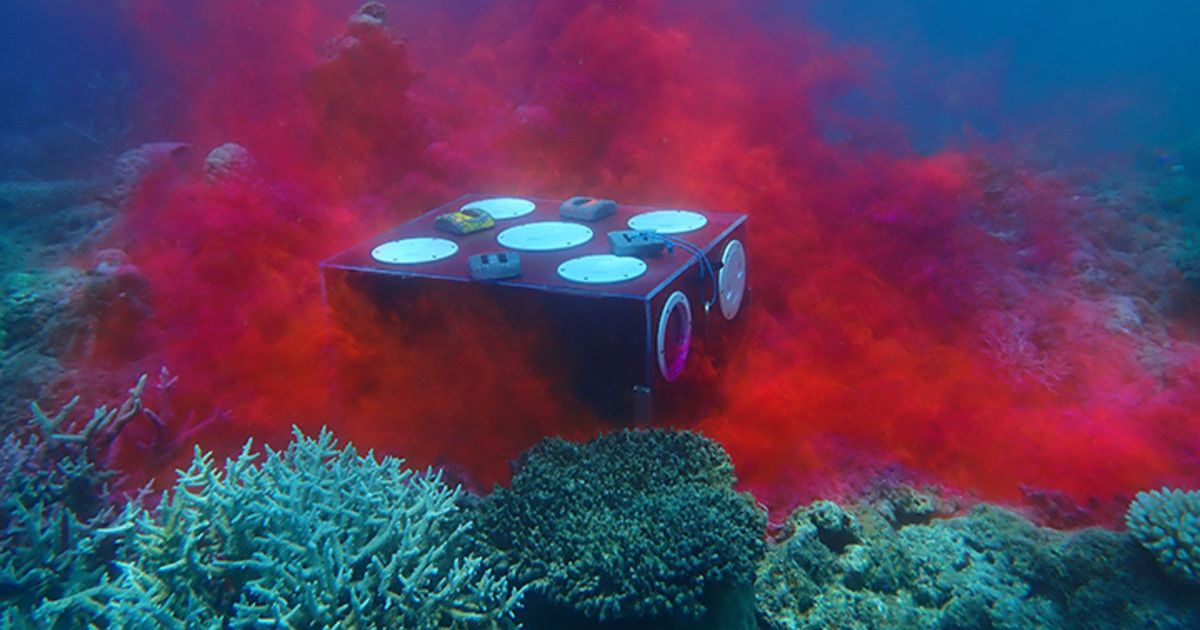
Coral larvae seedbox dye used in a trial undertaken at Lizard Island in 2024. Photo: G CARLIN


RESEARCHERS from Southern Cross University are helping save the Great Barrier Reef through a new coral restoration technology.
Developed in partnership with Australia’s national science agency CSIRO, the ‘larval seedboxes’ act to delay the dispersal of concentrated coral larvae in degraded reef areas.
Results from the first trial, conducted on Lizard Island in 2024, found coral settlement to be up to 56 times higher across thousands of square metres of reef.
A second trial was carried out in parts of the Whitsundays previously impacted by extreme weather events and coral bleaching caused by warming seas last year.
“The team will continue to monitor the longer-term effectiveness of the larval seedbox delivery over nine to 12 months,” SCU professor Peter Harrison said.
“This will help us understand how far some of the coral larvae disperse after release, and how effective the approach is in different reef environments.”
CSIRO senior research scientist Dr Christopher Doropoulos said the larval seedbox is a simple, efficient and cost-effective tool to help increase coral larval survival, delay their dispersal and find optimal habitat for settlement.
“The seedboxes work as a delivery system, allowing coral larvae more time to disperse and settle on the Great Barrier Reef, where they can establish themselves and grow into juvenile corals.
“We culture coral larvae following coral spawning, an annual mass reproductive event where many different types of corals release bundles of eggs and sperm into the water to fertilize externally.
“This enables us to collect tens of millions of coral larvae from mass cultures to fill the larval seedboxes.
“The larval seedboxes are deployed onto the reef, from which the larvae exit when ready and drift with the currents to cover areas of more than two hectares of reef. This approach delivers a high density of larvae over much larger areas than previously demonstrated, boosting coral restoration potential at scale.”
Following the assessment period, researchers will be able to determine the feasibility of the larval seedbox as a tool for coral restoration at larger scales across different environmental conditions.
The research is supported by the Great Barrier Reef Foundation in partnership with the Australian Institute of Marine Science and local Whitsundays stakeholders, including reef tourism operators and Traditional Owners, as part of the Boats4Corals project.
Share


Related Articles
Council groups recognised for major environmental and infrastructure achievements
LOCAL restoration projects were recognised at the Local Government Professionals…
Eungella asbestos dump highlights ongoing illegal disposal issue in the Tweed
A recent incident of illegal asbestos dumping at Eungella has…