Local artist chosen for Beijing Biennale
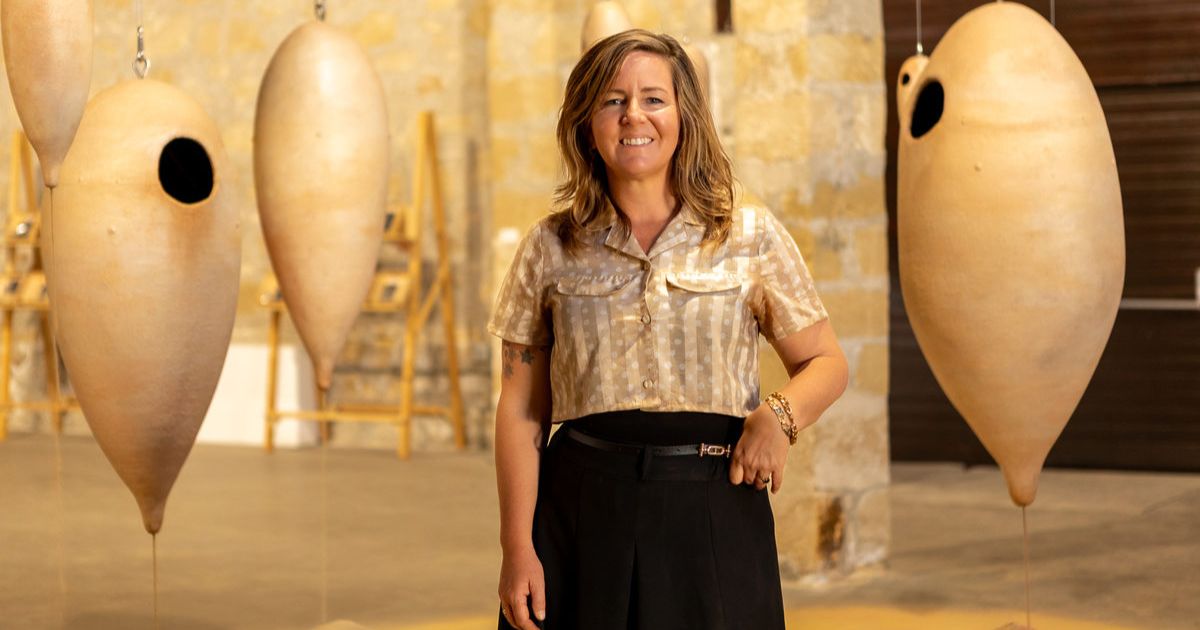


NORTHERN Rivers-based artist Karma Barnes has been selected for the 10th Beijing International Art Biennale following her Grand Prix win at the Larnaca Biennale 2025 in Cyprus earlier this year with the work CO-Lapses.
The Beijing Biennale is one of China’s largest and most influential international contemporary art exhibitions.
It runs under the theme ‘Coexistence’, inviting artists from around the world to explore the deep interdependence between people, nature and society.
Barnes has been based in the Northern Rivers for 15 years, working across the arts and exhibiting locally and internationally.
She has also worked as an art therapist in adolescent mental health and contributed to creative recovery initiatives following major natural disasters.
Barnes said living in the Northern Rivers during repeated fires, floods, and landslides had made the themes deeply personal.
“I’m often looking for ways to translate large ideas like time, landscape, and environmental change into forms that are intimate and human-scaled,” she said.
“Using small units like grains of sand or the architecture of mud-wasp nests allows me to speak about much bigger systems. Distilling these macro processes into a micro performance makes them visible and relatable, especially in the context of climate change and the way we adapt, rebuild and find meaning in unstable environments.
“The work became a way to understand how external forces, environmental, social, and emotional, leave marks on us over time.
“By working with materials that shift slowly and continuously, I’m exploring how we live alongside change, how resilience forms and how our relationships with place.”
Barnes said CO-Lapses came from a larger project called Relative Terrains, which was developed after living through the several natural disasters in recent years.
“Like many people here, I experienced these events not only as environmental crises but as profound social and emotional disruptions,” she said.
“Working in creative recovery and adolescent mental health made the psychological impact even clearer. I saw how our communities absorbed shock, regroup, support one another and carry collective memory through ongoing uncertainty.
“I first used the geology of the region, erosion, sediment movement, volcanic soil and the pressures of deep time, to understand how external forces shape our inner landscapes, and CO-Lapses extends that thinking.
“Climate adaptation here is lived, not theoretical, and the work reflects how we navigate vulnerability, rebuild meaning and find our way within a landscape and community that continues to shift and transform.”
For information, visit karmabarnes.org
Share


Related Articles
Murwillumbah stages first flood drill
PANCHO SYMES MURWILLUMBAH has staged its first community flood drill,…
Wellness Tourism Summit returns to Byron Bay with new resort host
THE latest global trends in holistic travel, emerging market opportunities…