Property industry backs state push to fast-track growth areas

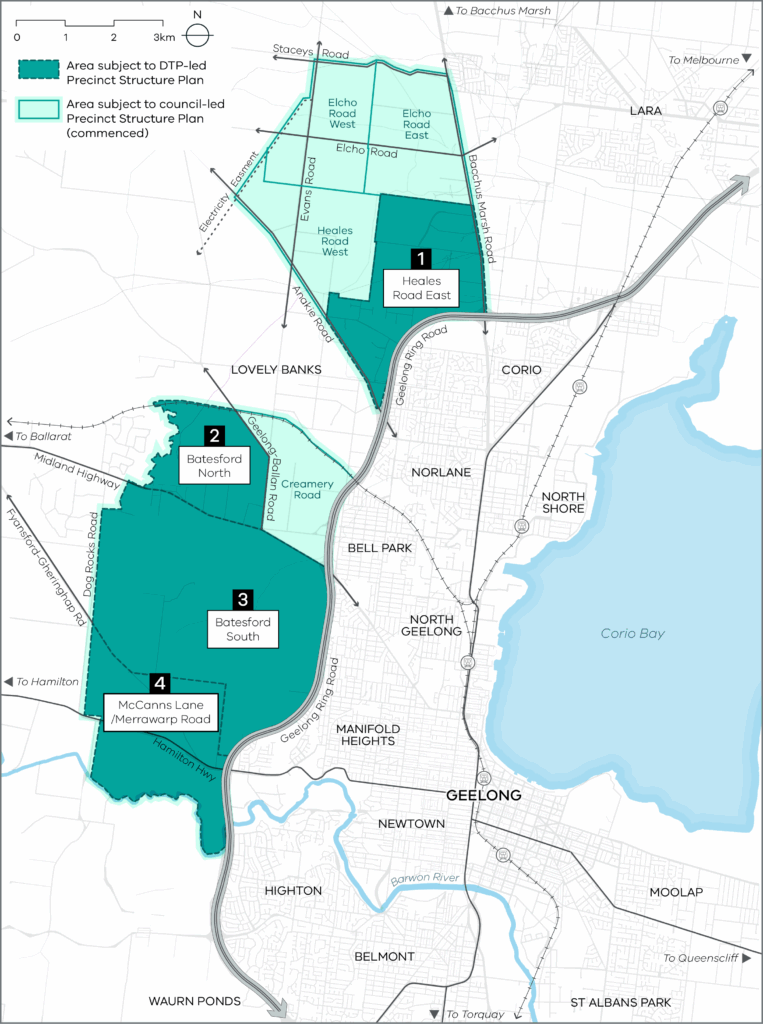
The northern and western growth areas in Geelong will eventually have a population of 110,000. Photo: City of Greater Geelong.


PROPERTY industry leaders have backed the state government’s decision to take control of planning for two of Geelong’s largest growth areas, saying it should accelerate housing delivery and reduce uncertainty for developers.
The state government announced last month the Department of Transport and Planning would take over four precinct structure plans in Geelong’s western growth area south of Lovely Banks and northern growth area near Lara, aiming to fast-track housing, roads and infrastructure for about 66,000 future residents.
The state government claims the city was three years late in sending the four PSPs for approval and its intervention meant they would be developed a decade sooner.
Geelong deputy mayor Eddy Kontelj disputed the criticism, saying the projects had faced delays outside council’s control and the state had never raised formal concerns.
But Colliers senior executive for sales and leasing Chris Nanni welcomed the state’s decision, saying it would provide certainty after years of delays.
“It’s exciting to have a government-backed program that is funded and well-resourced to assist bring these housing projects on,” he said.
“The region has been waiting for this for some time. These PSPs have been at the council’s desk since 2020.
“I’m really excited to see some progression, and so will the landowners and the developers out there.”
Villawood executive director Rory Costelloe said he understood why the state had stepped in, despite being disappointed the council had lost control of the process.
“It’s probably sad that the council’s lost control of it, but I understand why the council’s lost control because they’ve just elongated and stretched out the PSP process,” he said.
Villawood is developing part of the Creamery Road PSP, which is still being delivered by the city, and Costelloe said delays meant that project was running two years behind.
While Costelloe did not believe the state government was inherently better at delivering PSPs, he said it brought greater experience and a more commercial approach to the process.
Nanni said the change would not immediately affect land values or construction costs, but would improve confidence by providing clearer timelines.
“Developers and landowners have been sitting on land with no timeline, and that’s really hurt their feasibility because they can’t put an end date into it,” he said.
“Two of these PSPs will be committed to in two years’ time and the balance will be two years after that. So it provides some stability, an outcome and it de-risks their project a little bit.
“Nothing changes materially right now, but it’s positive momentum in the right direction.”
Costelloe said prolonged delays had real financial consequences for developers, particularly as construction and infrastructure costs continued to rise.
If costs become too high, he said, developers faced the choice of either cancelling the project or lifting the price of blocks.
“In the end the buyer becomes the one who suffers from delays,” Costelloe said.
Geelong’s northern and western growth areas are the largest urban growth project in regional Victoria and are expected to accommodate more than 110,000 residents when complete.
Nanni said unlocking the two growth areas would play a key role in lifting Geelong’s population to the forecast 440,000 by the mid-2040s.
“What new housing does is provide more jobs, it grows the economy and it adds to our infrastructure,” he said. “It’s a good message.”
Share


Related Articles
Public and Catholic school teachers continue bargaining into term 3
VICTORIAN public and Catholic school teachers are continuing their fight…
Geelong workshop wins top employer award
A Geelong automotive business has been recognised as Victoria and…