Cam Mooney: Geelong’s depth is being tested at the worst possible time
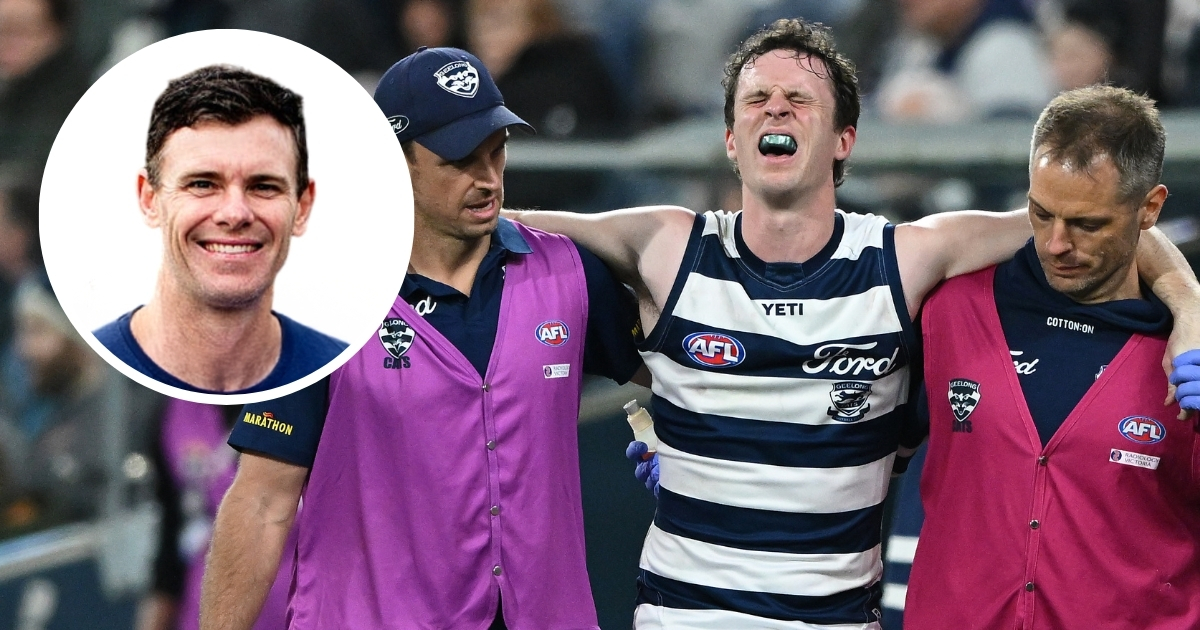
Max Holmes leaves the field after suffering the ankle injury that will require surgery during Geelong's win over St Kilda. Picture: James Ross/AAP


Geelong’s win over St Kilda came at a massive cost, and the club now has to rethink how it wants to play over the final part of the season.
Max Holmes will undergo surgery on a fractured ankle and syndesmosis injury, while Jeremy Cameron is also facing four to six weeks out after shoulder surgery. Shaun Mannagh finished Thursday night on the bench with hamstring tightness as well.
That is not just a few names missing from the team sheet. That is run, connection, scoring power and forward pressure all being stripped from the side at once.
Holmes has arguably been Geelong’s best player this year. His ability to break away from congestion, cover the ground and connect the back half to the forward line is central to how the Cats move the footy.
You do not replace that with one player.
The temptation will be to ask Bailey Smith to do even more, but Geelong cannot put the whole load on him. He was outstanding again against St Kilda with 35 disposals and a goal, but the answer has to come from the system.
The wings need to work harder. The half-backs need to be brave with their ball use. The midfielders must share the running load, and the forwards have to present clearly because the delivery may not come with the same speed it did when Holmes was bursting through the middle.
Then there is Cameron.
Losing your best forward changes everything ahead of the ball. He creates space, works high up the ground and drags defenders into uncomfortable positions. Without him, Geelong cannot simply bomb the ball long and expect the forward line to sort itself out.
That is why Jay Polkinghorne’s debut was so important.
The young key forward looked comfortable from the moment he kicked a goal with his first kick. He finished with two goals and three behinds, took strong marks and competed well against Callum Wilkie.
The misses did not worry me. Young forwards miss chances. Old forwards miss them too. I certainly proved that at different stages of my career.
The important thing is that Polkinghorne kept getting to the right spots. He led at the ball carrier, competed in the air and gave Geelong a target. With Cameron unavailable, that is now more than a promising debut. It is a genuine selection opportunity.
Geelong should not expect him to replace Cameron. That would be unfair. His job is to compete, bring the ball to ground and make defenders accountable. The scoring load then has to be shared by Ollie Henry, Shannon Neale, Gryan Miers and the midfielders pushing forward.
Miers’ return was another major positive. He kicked three goals, had 22 disposals and brought class back into the forward half. His connection with the forwards becomes even more important now because Geelong has lost two of its best ball movers in Holmes and Cameron.
Inside a club, this is where roles become everything.
Players do not need to become stars overnight. They need to understand exactly what the team requires from them and deliver it every week.
Geelong still has experience, depth and a strong system. But the margin for error has tightened quickly. The Cats now have to prove their structure can survive without the two players who give them their greatest attacking weapons.
Listen to The Run Home with Worlo & Moons on SEN Geelong, Mondays and Fridays from 3–5pm, via the SEN App.
Share


Related Articles
Teacher strike confirmed as AEU members reject revised pay offer
Thousands of Victorian public school teachers will strike on Thursday…
Whole-hearted effort to save sacred church
WHEN termites were discovered in the foundations of Inverleigh’s Sacred…