Committee for Lorne: Monsters, Myths, and a Monk


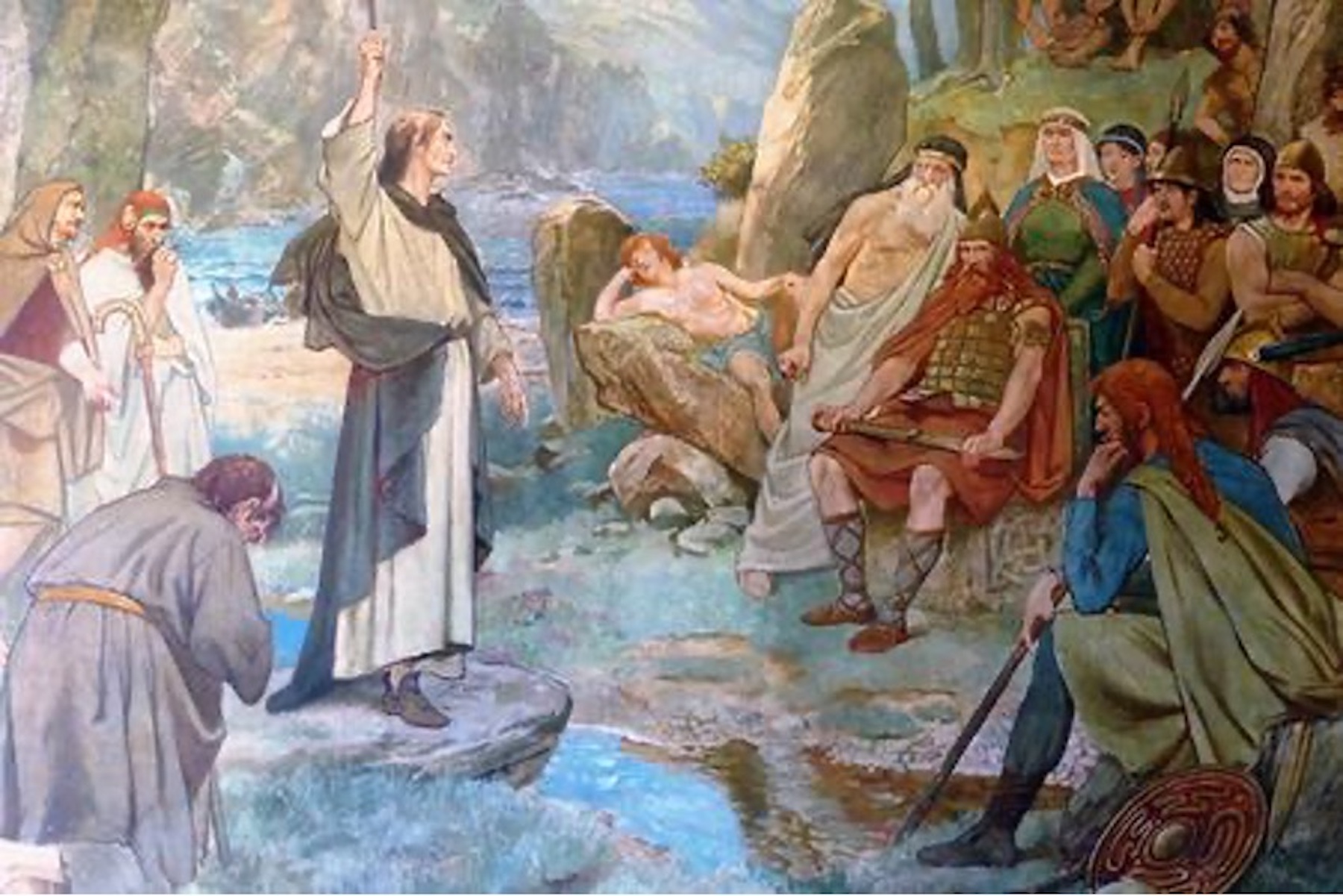
[Scottish National Portrait Museum]
This article departs from the usual surf-coast emphasis of this page, as June 9th marks a pivotal moment in Scottish historical lore and should not pass without acknowledgement, given the many coasters who share Scottish heritage and the monsters—such as panthers and quangos—that some believe haunt our local hills.
While historical dates of death are often uncertain and prefaced with a ‘c.’ indicating ‘circa’ [thereabouts, or approximately], this isn’t the case with St. Columba [in original Gaelic, St. Colmcille], a foundational figure for those with Gaelic, Western Islander [Hebridean], or other Norse/Scottish roots—think Clans MacDonald [Donald], MacLeod, Maclean, MacDougall, and MacNeil, among many others. St. Columba is known to have died precisely on 9th June, AD 597 [i.e., 1,429 years ago last Tuesday]!
St Columba’s Feast Day [https://tinyurl.com/4ve9rksu] is celebrated throughout the Western Isles of Scotland, where the saltires fly each year in his honour, even though his influence was neither military nor nationalist but entirely ecclesiastical. But … what an influence, what a man!
As Islander blood [albeit diluted] still whooshes through my veins, I couldn’t let the day pass unmarked … even here, on the other side of the world … hence, today’s tangential detour to our distant coastline.
The rest of this article is a heavily edited version of Angelo Stagnaro’s fascinating blog post about Saint Columba [see: https://tinyurl.com/mwcj988y].
Saint Columba was born into a noble Irish family in Tyrconnell [in County Kildare], where he received ecclesiastical training and founded several monasteries in Ireland before crossing in an open, skin-covered coracle to the Scottish peninsula of Kintyre in c.563 AD. Settling on the nearby Hebridean island of Iona [known now as the Holy Isle], he founded the sacred Abbey of Iona, from which he spread Christianity among the pagan tribes and clans of the north.
This, however, is only a small part of his résumé, for he was also a statesman, a diplomat, a historian, an author and a poet, revered by both the Scottish and the Irish, who remain eternally grateful to him for ‘civilising’ their pagan ancestors and for offering them the promise of salvation and an eternal reward.
Exact dates are a feature of St. Columba’s story, for it is also recorded that on August 22, AD 565, St. Columba performed the miracle that would secure his saintly aura down the ages, for it was on this fateful day that he made short shrift of the legendary Loch Ness Monster.
What, you may ask, could St. Columba and ‘Nessie’ have in common?
The story of Columba’s ‘monstrous encounter’ is told in graphic detail by St. Adamnan, Columba’s biographer and a later Abbott of Iona, in his ‘The Life of Saint Columba’—though it was written over a hundred years after the alleged events. Nevertheless, Adamnan’s account is the first written record of the Loch Ness Monster.
Adamnan tells us that: “… while standing on the bank of the River Ness, which flows out of Loch Ness in northern Scotland, Columba was contemplating the best way to cross to the other side. Nearby, a group of heathenish Picts were busy burying a friend who had been attacked by an enormous ‘water beast’ while swimming in the river. When Columba knelt beside the dead man and laid his staff across the dead man’s chest, the man miraculously stood up, hale, hearty and fully recovered.”
Next, against all common sense, Columba ordered one of his fellow monks to swim across the loch and bring back a small boat moored on the opposite shore. The monster, alerted by the monk’s splashes, surfaced, roared a mighty roar, and raced towards the hapless monk with its mouth wide open. When all on the shore cried out in warning, Columba stepped to the edge of the loch, made the sign of the cross, and, invoking the Name of the Lord, commanded the monster: ‘Go no further. Do not touch the man. Leave at once!’
The monster, by then no more than a spear’s length from the struggling monk, was terrified by the sound of the saint’s words, stopped, turned, and fled.
Adamnan further records: “… the monster moved ‘as quickly as if it had been pulled back with ropes’ and absconded to the depths of the loch behind him, allowing the monk to retrieve the boat and paddle it back unharmed. Everyone was astonished. The heathens were so impressed by how Columba had brought their friend back to life and had commanded the monster that they gave glory to the God of the Christians, converted on the spot, and were baptised in the waters of the River Ness.”
Columba was known for performing hot and cold miracles as easily as turning on a tap. He regularly cured the sick, the disabled and the lame, produced water from a rock, calmed storms at sea, subdued savage beasts such as boars and serpents, provided fishermen with a bounteous catch, multiplied herds of cattle, exorcised demons, and brought peace to warring factions … all of this, and more, without batting an eye.
As I marvel at the abilities of this Scottish Saint and thaumaturge [https://tinyurl.com/b3u9ht43], I can’t help but think of the times when a reincarnated St. Columba could have been a useful card up our collective sleeve here in Victoria, especially along our coast, when a bevy of miracles might have been just what the doctor ordered.
I can just imagine how cool it would be if a modern-day Columba could magically emerge, lay his staff across our potholed roads, calm the factions warring over coastal improvements, summon back the couta, dispel all threats of wild beasts [esp. panthers] from our forests, and, as a special favour, balance the competing pleasures of coastal living against the ever-rising demands of tourism.
Who knows … maybe miracles do still happen.
John Agar
Feature Writer
A word from the chairman
Hello
Coming home to Lorne after a holiday away is a special experience! Not only are we quickly reminded of the natural beauty of our hometown, but the warm greetings from so many friends reinforces the meaning of “home” and reminds us of what it means to live in a “community”.
And what a King’s Birthday long weekend it was to come home to! Even as winter proper sets in, the sun shone, the visitors came in numbers and our accommodation providers, cafes and restaurants were having their last major flourish before heading into hibernation for a few months. The Foreshore Market run by Lorne School morphed into the Carpark Market, as the lawn area was considered too wet after drenching rains last week. While the turnout of stallholders was reduced, there were plenty of opportunities to spend money and raise much needed funds to support our school.
The Aquatic Club is now securely settled into its temporary home at the Surf Club. There was a big turnout on Friday night for the monthly Snappers catchup, followed by the annual Sausage Roll competition on Sunday. Approximately 300 members and guests came to taste the artisan creations of our local amateur chefs, with Ric Addison taking the major prize for best sausage roll, a well-deserved winner! Ric had lots of practice as he once again produced 200 samples for the assembled crowd to taste.
Meanwhile down at Point Grey, things are proceeding apace with preparations for framing at the Aquatic Club and the pouring of the concrete slab for the new Co-op building imminent. We watch the progress with excitement!
I want to thank my friend and deputy, Pete Spring, for writing this column while we have been overseas, but I do need to correct some misstatements in his recent writings. There was no “swanning”, “cavorting” or “gallivanting” around Europe. This was no junket, but a fully self-funded, carefully curated study and exploratory tour, intended to bring back information and ideas to assist the business and social community of Lorne.
We marvelled at the engineering masterpiece that is the Swiss railway system, although obviously not as complex as the half-baked Cheltenham to Box Hill “suburban rail loop”.
We loved the practical approach to coastal dining in so many locations, with the policy, “Use and respect the environment and adapt as necessary”.
We were in awe of the amazing Sea Organ at Zadar in Croatia where 35 tubes of different diameters with whistles are implanted into the stone-paved waterfront so that the waves play seven chords of five different tones of music. The installation was the joint winner of the 2006 European Prize for Urban Public Space which described it as the “perfect place for watching the sunset over the sea”. Wouldn’t that be special for Point Grey or the pier. Look it up here – https://tinyurl.com/zadar-sea-organ.
We may have also sampled some local produce and beverages, and we have passed on our findings to our local restaurants.
Cheers (and it’s great to be back home)
John Higgins
Chairman
Lorne Ward Events Calendar
June
20 Lorne Dolphins Football and Netball V Western Eagles, at Stribling Reserve, juniors match from 8:45am, seniors at 2pm
20 Deans Marsh Winter Solstice, Coming together for food, song and dance, we pause and joyfully celebrate the longest of nights. 5-9pm at Deans Marsh Hall & carpark
Share


Related Articles
Lara’s path back to senior competition revealed after review uncovers club-wide issues
Lara Football Netball Club has three months to prove it…
Opposition leader Jess Wilson makes her pitch to local voters
Opposition leader Jess Wilson says the Geelong region has been…