The Geelong vet caring for racing royalty
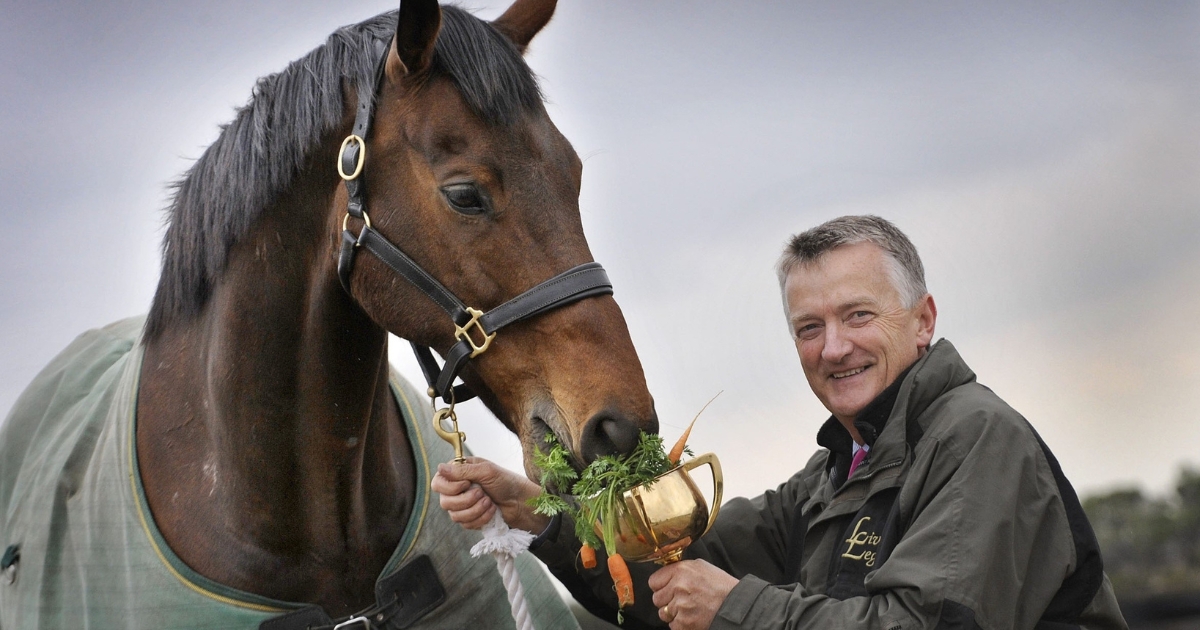
Dr Andrew Clarke feeds legendary thoroughbred Might and Power. Photo: Living Legends.


A lifetime spent working with and studying horses has convinced Dr Andrew Clarke there is a deep evolutionary link between the animals and humans.
The Belmont resident has lived in Geelong for two decades but his equine and veterinary work since the 1980s has taken him to universities not only in Melbourne but also in England and Canada.
His contribution to equine welfare was recognised in this year’s King’s Birthday Honours List, with Dr Clarke receiving a Medal of the Order of Australia (OAM).
Now 71, Dr Clarke continues his work in equine research and education with the help of some of Australia’s greatest retired racehorses.
He grew up on a farm with trotters bred for harness racing and turned a career as a vet into a career in equine research, which Dr Clarke said allowed him to put theory into practice.
“Researchers are often good at making a new discovery and then they want to move on to the next one, but when you work in industry, it’s to get the practical applications of the research and keep research focused on practical things,” he said.
This work eventually led to the formation of Living Legends: The International Home of Rest for Champion Horses, a home for retired champion racehorses that attracts thousands of visitors each year.
The centre will celebrate its 20th anniversary this year, and Dr Clarke has been chief executive since its inception.
He said it was inspired by a desire to keep Melbourne Cup winners and other well-known racehorses in the public eye.
“You go to the tennis and Rafael Nadal and McEnroe and all these different players are there; they’re the legends and heroes of tennis,” he said.
“With football, you’ve got the all the great football players.
“So really, the idea was to have the legends and heroes of thoroughbred racing here for the public.”
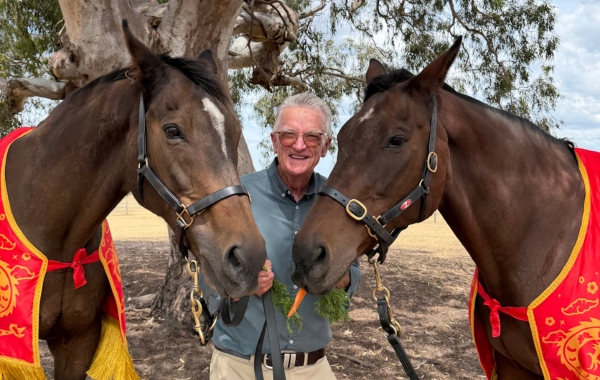
The stables host Melbourne Cup winners Prince of Penzance, Twilight Payment and Almandin, while the property’s gardens are the final resting place of local and international champions including Bay Story, Better Loosen Up and Doriemus.
As well as hosting more than 150 students on placements each year, Living Legends allows visitors to get up close to a species that has shared a unique bond with humans for thousands of years.
“I think humans’ involvement with horses is almost primal because as people evolved, if you had a good horse, you could travel with a horse, you could farm your property, you could protect yourself and more,” Dr Clarke said.
“People will eat a sheep, they’ll eat a cow, but not a lot of people will eat a horse.
“Even with kids – we get school kids here and we show them how to feed a horse a carrot, and they feed a horse a carrot from their hand and they think they’re the man or woman from Snowy River.”
Dr Clarke said one of the biggest changes in veterinary science during his career had been the growing focus on the care of ageing horses.
“It’s a whole new area that people are focusing on a lot more, so it’s just so special to be able to help them,” he said.
Reflecting on his OAM, Dr Clarke said the honour was totally unexpected but he was very grateful.
“It’s more of a reflection on the people I’ve been able to work with and the groups and teams we’ve put together,” he said.
Other Geelong recipients recognised in this year’s King’s Birthday Honours List included Newtown resident Rodney Payne, who received an OAM for service to the community through the not-for-profit sector, including with Karingal St Laurence and Geelong Connected Communities.
Highton’s Kenneth Kinloch was also awarded an OAM for service to youth and the community, including through the Scouts, the Geelong Central Rotary Club and Give Where You Live.
Share


Related Articles
Geelong negotiating possible early exit for Tyson Stengle
Geelong has begun discussions with Tyson Stengle’s management about a…
Spilt Milk festival finds new home in Geelong
One of Victoria’s biggest annual music events is heading to…