Committee for Lorne: And still the sea comes…



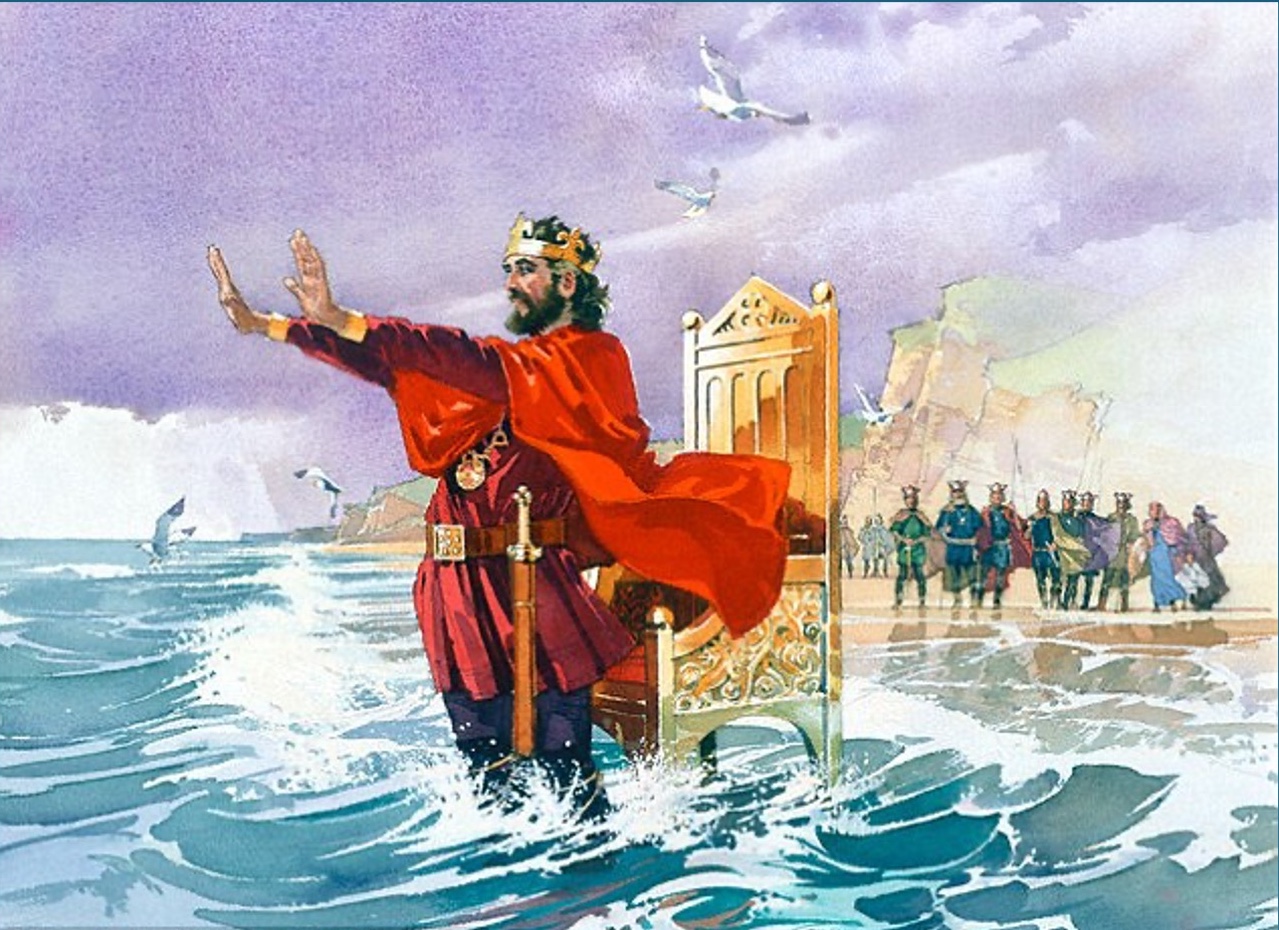
I love standing, watching my hairy little four-legged friend fishing for minnows among the water-smoothed jumbles of sandstone and lignite that dot the beach at Spout Creek while simultaneously playing the game of ‘Hold Back the Tide’ once popularised by the unfairly ridiculed pre-Norman English monarch, King Cnut [now known better as King Canute]. Unfortunately, I have lost the art of a nimble retreat that was a feature of my youth, and—just like Canute once did—I regularly cop a wetting.
Canute was, in truth, one helluva king. A wise warrior-king who conjointly ruled Denmark, Norway, and England, Canute brought stability and peace to all three kingdoms. Indeed, many would rate him among the top three post-Roman, pre-Norman rulers of England, alongside Alfred the Great and the mighty King Aethelstan.
As with most of the early English monarchs, tales—many tall, some true, all embellished, many unfair—swirl around their lives and achievements, with all three owning unique legends.
Alfred, for example, will never live down the over-crisping of his oatmeal cookies while training for a Dark Ages precursor to MasterChef. While revered as the greatest of all England’s pre-Norman kings … he hammered the invading Vikings [my ancestral ‘rellies’] and drove them back from his west-country precursor kingdom, Wessex, as any devotee of the TV series ‘The Last Kingdom’ will confirm … baking was clearly not his strong suit, and his lack of culinary smarts dogs his memory to this day.
Meanwhile, his grandson, Aethelstan, is credited with disposing of 34,800 Viking and Scottish warriors [yet more of my ‘rellies’] all in a day’s work at the Battle of Brunanburh near modern-day Liverpool, although it is hard to believe that they were all personal kills! Nevertheless, this extraordinary victory over a vastly numerically superior army formed from an alliance between Olaf Guthfrithson’s Vikings, Constantine II’s Scots and the Strathclyde Britons, undoubtedly secured for Aethelstan his widely acknowledged status as the first true King of (all)England.
Canute—my Spout Creek inspiration—was, despite his Viking pedigree, a towering and all-powerful ruler. He brought peace and unity to the turbulent peoples of England, whether Anglo-Saxon or Viking, in the years just before William, the bastard of Normandy, invaded to defeat Harold Godwinson at the Battle of Hastings in 1066 and establish Norman England.
Every school child will [or should have] heard the Canute story: of how he stood at the ocean’s edge on an incoming tide and imperiously ‘commanded’ the sea to retreat in order to demonstrate his omnipotent powers. Of course, it didn’t, and—as legend has it—Canute coped an embarrassing dousing.
But while there is reasonably strong documentary evidence that the event actually took place [King Cnut and the tide: Wikipedia], it turns out that Canute’s intent was to demonstrate the exact opposite … to show that the power of an earthly king was finite, that the sea would advance despite his royal status, and to deliver the message that all men [even kings] were impotent in the face of God. To drive his lesson home to his court, good King Canute chose to ‘take one for the team’ while [presumably] his minions were warming fluffy white five-star towels by a roaring fire farther up the beach.
The legend of Canute’s dousing should not be lost on us, especially those of us lucky enough to live at the edge of the ocean. His lesson? The ocean will come … indeed, it will always come … and any works of man will be powerless to prevent it.
Like a planetary tide set to a multi-millennial cycle, sea levels have risen [flooded] and fallen [ebbed] since earth-time began. 20,000 years ago, the oceans were at an ebb, and land bridges opened everywhere. Bass Strait was verdant pasture, while to our north, Cape York and New Guinea were conjoined, as were the island chains of Indonesia. In the northern hemisphere, Kamchatka and Alaska were joined by a chain of mountains—now the Aleutian Islands—and the Bering Strait was a land bridge between northern Asia and the Americas. In Europe, England was connected to the Low Countries by the Doggerland, and the current Baltic Sea was pastureland. Human and animal migration used these corridors until the oceans began flooding again, and the ‘bridges’ disappeared, isolating those who had crossed from their earlier homelands.
Those of us with long memories of Lorne will tell you that high tide never reached high enough to lap the foot of the cliffs at Lorne Point, that Point Grey never ‘went under’, and that the sandy verges of the GOR were never under erosive threat as they are now. Most accept that ‘revetments’ … a fancy French name to lend bureaucratic gravitas to what most would call seawalls … are a prudent step at Point Grey. Indeed, they are and must be along the lower-lying stretches of the GOR at Eastern View, Apollo Bay, and several places in between.
But in the end, these will be no more than puny barriers to the oncoming sea as Mother Earth continues to surge—with a mere smidge of human help—through her time-immemorial cycles of heating and cooling. As coastal engineers around the world seek to hold back the inevitability of the sea, like so many modern-day King Canutes, we should not forget that, despite their best efforts—and the often-irrational anxieties of climate activism—our feet will get wet, and the sea will always come.
John Agar
Feature Writer
A word from the chairman
Well, the first weekend of May was a busy time in Lorne. Stribling Reserve hosted Otway Districts for four games of football and seven games of Netball. Lorne featured in the Cadel Evans Great Ocean Road Race with the longest of the races passing through Lorne on the way from Skenes Creek to Torquay. Then on the Saturday afternoon, Always Live, supported by the Victorian government, hosted three pop up musical events at various locations on the main street and foreshore. The weather was perfect, like Autumn in Lorne always is – the best time! It was great to see so many visitors in Lorne on the weekend. Hopefully, it provided a boost to our local businesses who did it tough over the summer season.
The Lorne Dolphins footy teams had a great day with all teams winning. There were some close games in the Netball with Under 17 and D Grade teams victorious. And then to see the following post on social media: “Our fabulous Bellbrae Dolphins under 12 girls had their first win today!! Amazing coach Alex Adams has worked tirelessly to teach the girls the game and passion for fun, friendship and footy! Well done to all”. So, we now have a Dolphins Girls team winning as well! Amazing!
Last week, Surf Coast Shire announced the Local Legends for 2026. There are four categories; Community Commitment, Community Impact, which are awards for individuals. Then there is Group Volunteer Excellence and Community inclusion which recognises groups. Amongst the candidates for the Group Volunteer Excellence award there is the Lorne Community Flood Responders. This is a fitting tribute to the members of the Lorne Community just “turned up” on the evening of 15th January when, as a result of torrential rain on the ridge of the Otway Ranges, the rivers from Wye River to the Erskine River flooded with volumes of water not seen for many years rushing to the ocean. On that evening in Lorne campers were evacuated from the Erskine River Caravan Park. Stribling Reserve Community Pavilion was opened up for these campers to provide somewhere warm and dry and to have a hot shower. When the extent of the flooding at Cumberland River became known, Stribling Reserve was officially declared an Emergency Relief Centre. Cary Stafford, Principal of Lorne P-12 College, made one of the school buses available to transfer campers from Cumberland River. Keith Miller, Commodore of Lorne Aquatic Club made the club bus available. Kev Van Deuren and Paul Spizzica “turned up” to drive the buses. The ladies of the Op Shop “turned up” at Stribling with loads and loads of dry clothing. And the people of Lorne “turned up” to offer accommodation in their homes to families affected by the floods. Most of the 300+ campers who arrived at Stribling with nothing but the wet, muddy clothes on their back were accommodated that night in family homes. An amazing effort Lorne Community. Give yourselves a big pat on the back!
There will be a Lorne Volunteer Afternoon Tea hosted by Surf Coast Shire on Thursday 21 May, 2.30pm to 3.30pm at the Lorne Historical Society to celebrate Volunteering and the Lorne Community. Come along.
On behalf of Chairman John Higgins who is still slumming it in Europe
Pete Spring
Lorne Ward Events Calendar
May
16-17 Great Ocean Road Running Festival, Running, music, wellness, adventure.
23 Lorne Dolphins Football and Netball V Alvie, at Stribling Reserve, juniors match from 8:45am, seniors at 2pm
June
7 LAAC Fishing Comp No. 4, Weigh-in cut off 12.30pm. Free roast lunch for members & competitors, presentations will all be held at Stribling Reserve downstairs.
20 Lorne Dolphins Football and Netball V Western Eagles, at Stribling Reserve, juniors match from 8:45am, seniors at 2pm
20 Deans Marsh Winter Solstice, Coming together for food, song and dance, we pause and joyfully celebrate the longest of nights. 5-9pm at Deans Marsh Hall & carpark
Share


Related Articles

Lara’s path back to senior competition revealed after review uncovers club-wide issues
Lara Football Netball Club has three months to prove it…
Opposition leader Jess Wilson makes her pitch to local voters
Opposition leader Jess Wilson says the Geelong region has been…