Committee for Lorne: R [15], S[10] — I think the R’s have it.



I have always enjoyed language and, hopefully, seek [or try to seek] its proper use. This past month, my language antennae have been set to ‘maximum twitch’ on two fronts.
First, as a self-confessed budget addict—I watch it every year with a hearty McLaren Vale red, two simmering hot dogs, some bread, and lashings of Rosella tomato sauce all at hand—I suffer my yearly dose of masochism.
This year, the delivery of the Federal Budget was little different from usual, except that the Treasurer shamelessly used the same two buzzwords that also overpopulate a sign recently erected at the Erskine River mouth by the Great Ocean Road Coastal And Parks Authority [GORCAPA] … aka a local quango that specialises in Grabbing Or Restricting Coastal And Parks Access.
Jim Chalmers couldn’t help himself as he repeatedly wove GORCAPA’s two recurring bureaucratic buzzwords—resilience and sustainability—into his delivery.
Sensing that these schmoozy words would come, I decided to count how many times each word appeared in the Treasurer’s 27-minute speech and scribble an ‘R’ or ‘S’ on my notepad each time he used them.
The aggregate was a staggering 25 times [‘R’ x 15; ‘S’ x 10], yet I was sadly unsurprised to find that as the budget progressed, the tally grew exponentially. Here—with tongue firmly in cheek—an aside … perhaps our political commentators could spice up next year’s telecast by adding [1] a terminology tally room or [2] conducting a national sweep for the most repeated word. But, on a more serious note, what the Treasurer’s speech did hammer home was the honeyed hackney of current political speak!
Don Watson, Paul Keating’s remarkable speechwriter and the author of the classic compendium of contemporary Australian clichés, ‘Weasel Words’, would have had a field day. Since its first publication in 2004, Watson’s lexicon of ‘weaseliness’ has been burgeoning. Like a pandemic of illiteracy, it has spread to and infected even the lowliest middle managers and clipboarders in the land.
Although Jim Chalmers’ use of his favourite sentinel ‘R’ word in the 2026/27 budget speech was undeniably impressive, our own local quango [GORCAPA] has at least twice beaten him into a poor second—first with a new sign at the Erskine River mouth and again with a videoclip on their website.
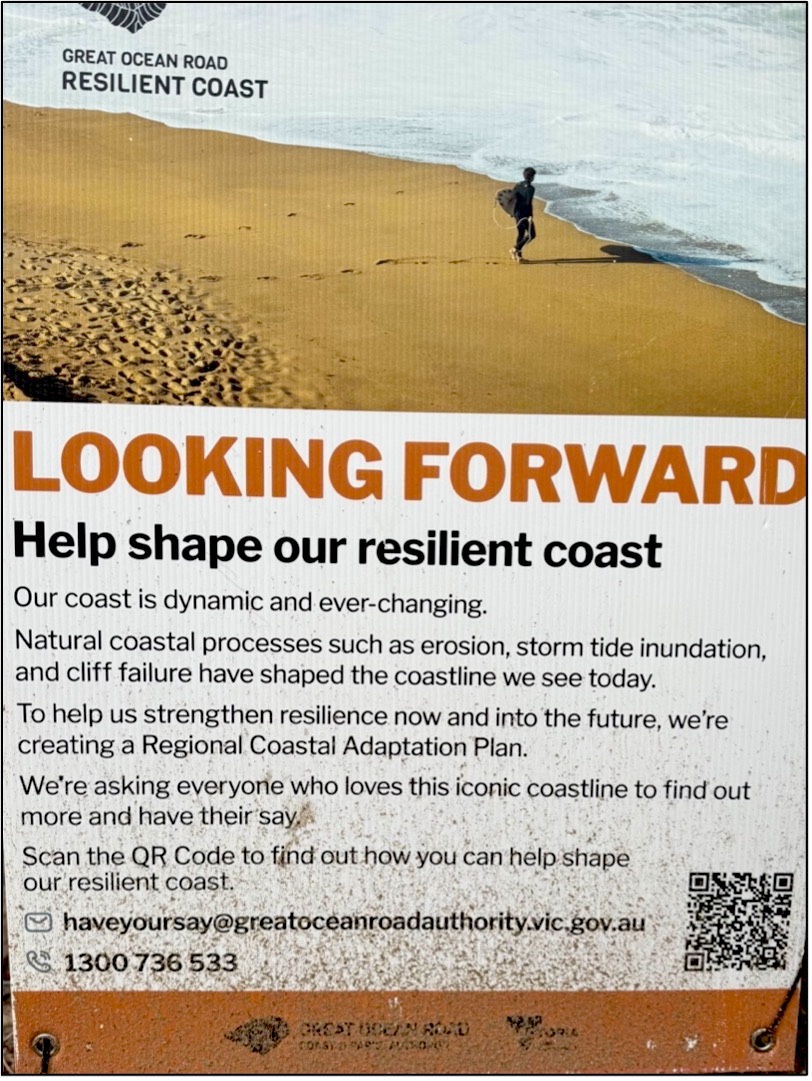
The sign is self-explanatory [see attached photograph]. Meanwhile, the website features a 2:49-minute clip—‘Coastal Adaptation Plans Explained’—in which the word ‘resilience’ or ‘resilient’ is repeated seven times [or once every 24 seconds]. You can find it here – https://tinyurl.com/coastal-adaptation. I cannot deny that I felt like adding one more ‘R’ of my own for having the ‘resilience’ to listen to the end.
The website also features [among many other offerings] a pair of sentences as follows:
- “… the Great Ocean Road is subjected to coastal erosion and inundation due to more frequent storm events and increasing sea levels.”
This statement, while likely to be partly true, remains debatable. Whether storms now classified as ‘events’ [weren’t they once just bad weather?] are more frequent is arguable—and likely historically untrue—with much of the apparent increase in ‘events’ arising from a combination of [1] far more frequent reporting and [2] an ongoing and diminishing severity in the criteria that deem an event.
Decades ago, weather [hot, cold, flood, drought] had to be near-cataclysmic to be widely reported. Nowadays, a good 5-day easterly blow is seen by some as a weather disaster. A nicely balanced article from ‘Our World in Data’ can be found at: https://ourworldindata.org/disaster-database-limitations and is well worth reading before jumping to conclusions that our 21st-century sky is falling in.
- “… protecting and enhancing our iconic natural landscapes – and the State-owned infrastructure that sits upon them is a top priority.”
While a laudable statement that is, on face value, hard to challenge with the ‘protecting’ part a worthy aim, I do draw a line at ‘enhancement’.
Nature is natural, nature is marvellous, and it is beyond arrogant and presumptuous to think that humans might be able to ‘enhance’ nature in all its terrible beauty and power. Glory in it?—yes! Enhance it?—surely not. GORCAPA’s aim to ‘enhance’ smacks of misplaced conceit, as is represented by its interference with the natural awe of the Apostles’ coast with its ‘architectural’ viewing platforms. Enhancement should never be about redesigning nature to suit our temporary liking.
Words matter. The overuse of words, however laudable their intent, can lessen their impact, even cheapen their outcome.
‘Resilience’ is a relatively recent buzzword addition. Don Watson did not list it in his superb 2004 lexicon of political platitudes and clichés: ‘Watson’s Dictionary of Weasel Words: Contemporary Cliches, Cant, and Management Jargon’. Nor did it appear in his second 2015 dip into the same topic: ‘Worst Words: A Compendium of Contemporary Cant, Gibberish and Jargon’. Resilience appears to be a Johnny-come-lately in bureaucratic-speak.
Googling ‘… the use of resilience as a bureaucratic buzzword’, the following AI summary paragraph popped up and while I normally resist using AI in my articles, on this occasion the response was ‘golden’. Google AI answered as follows:
“When ‘resilience’ is used as a bureaucratic buzzword, it often shifts the responsibility for systemic failures onto individuals. Instead of organisations or governments fixing toxic workloads, budget cuts, or environmental risks, they use the term to demand that employees or communities silently endure hardship without complaining.”
Googling a second question: ‘…when did bureaucrats fall in love with resilience?’ … AI returned an even more interesting response.
“Bureaucrats and policymakers ‘fell in love’ with resilience in two distinct waves: first in the early 2000s as a disaster-management framework, and permanently after the COVID-19 pandemic.
It shifted from an obscure term in ecology and psychology to a universal government buzzword used to justify budget cuts and manage crises.
The concept is inherently vague. For governments, resilience is an incredibly flexible tool—it allows bureaucracies to appear proactive and adaptable without committing to massive, expensive systemic reforms. It also subtly shifts the burden of surviving a crisis and an economic downturn away from state institutions and onto local communities and individual citizens.”
Governments, politicians, and local bureaucrats need to realise that, to gain their constituents’ trust and respect, they must speak and write clear Anglo-Saxon English, for we, the people, are full to pussy’s bow with complex managerial word salads and obfuscation.
John Agar
Feature Writer
A word from the chairman
Last week was National Volunteers week, an opportunity to recognise and celebrate those volunteers who just “get things done”. The Surf Coast Shire implemented a program called Local Legends which allowed our communities on the Surf Coast to nominate members of the community who, through their selfless contributions, were deserving of recognition.
The Shire held a range of events at Shire offices and within our communities to provide an opportunity for public recognition of the “legends”. In Lorne the event was held the newly refurbished rooms of the Lorne Historical Society followed by an afternoon tea upstairs at Lorne Community House. This provided an opportunity for the Historical Society to showcase its new, rather imposing façade, itself the product of the work of many volunteers, in particular the Lorne Men’s Shed which built the panels for the façade, the selfless contributions of local Architects Bob Sinclair and the late Chris Wood and the many, many people and organisations who supported the project.
Our own Doug Stirling was recognised as a local legend by a Community Commitment award. Doug is 103 years old and still an active member of the Lorne Men’s Shed. We believe that he is the oldest men’s shed member in Australia. During his time, Doug has contributed of 70 years of his time, energy and effort to a large number of community organisations in Lorne. Congratulations and well done Doug!
Just as significant was the recognition of the wider Lorne Community by a Community Commitment award. The citation on the award reads, in part; “When flash flooding of Erskine and Cumberland Rivers struck in January, sweeping away cars, caravans and tents and flooding buildings, roads and bridges, Lorne community members responded with remarkable speed, care and heart…..Lorne’s response demonstrated the best of a community coming together – protecting and caring for visitors, supporting neighbours and caring for Country…..Many small but meaningful acts combined to become a significant whole response which helped people feel warmly and securely supported and cared for in hours of sudden need.”
Take a bow Lorne Community, you deserve it!
The Point Grey redevelopment project continues at a steady pace. Significant changes are now visible and the drive in space, off the Great Ocean Road which allows the curious amongst us to park and have a look through the construction fence at what is happening. Most notable is the construction of the rock revetment wall building upon the rock wall that is in front of where the Aquatic Club once stood. The new wall is longer, higher and is, in itself, a bit of a work of art. The concrete slab for the new Aquatic Club has been poured and I am encouraged that my investment of $10, nominating 11am on Melbourne Cup Day, 2026 as the date and time that the first beer is poured, might not be too far wrong. The site of the Co-op has now been cleared and I understand the slab for the new building will be poured in the next couple of weeks. Let’s hope the new Point Grey precinct does justice to this important piece of Lorne’s culture and history.
It would be remiss not to recognise the milestone 80th birthday of our Feature Writer on this page and regular contributor to the Lorne Independent, John Agar. John celebrated last weekend with family and friends and it was a wonderful event. Happy Birthday John and here’s to many more!
Pete Spring
Deputy Chairman of Committee for Lorne
(continuing to fill in for our Chairman who, along with so many other Lorneites, continues to swan around Europe!)
Lorne Ward Events Calendar
June
7 LAAC Fishing Comp No. 4, Weigh-in cut off 12.30pm. Free roast lunch for members & competitors, presentations will all be held at Stribling Reserve downstairs.
20 Lorne Dolphins Football and Netball V Western Eagles, at Stribling Reserve, juniors match from 8:45am, seniors at 2pm
20 Deans Marsh Winter Solstice, Coming together for food, song and dance, we pause and joyfully celebrate the longest of nights. 5-9pm at Deans Marsh Hall & carpark
Share


Related Articles
Liberals defend safety of 110kmh freeway plan
The Liberals have dismissed concerns their proposed 110kmh speed limit…
Teachers walk off the job for second time as AEU pushes government for deal
Victorian public school teachers will strike for the second time…