Committee for Lorne: Parmageddon



There have been floods again up north. This time, Bundaberg has borne the brunt as the Burdekin broke its banks.
No one says enduring this is easy. The damage has been extensive, and the threats to land, livelihoods, and lives severe, as they are each time these events occur. Yet, time and again, and showing remarkable resilience, the locals—who have seen it all too often before—shrug it off and, as they always do, ‘get on with it’ and make the best of the situation.
On the TV news, I watched a young cub reporter from the big smoke conduct a handful of interviews with the locals. Clearly, he had never seen anything like this before. First came the usual inane, insensitive questions, like: ‘How does this make you feel?’, as the cameraman panned to the said locals’ house floating down the river in the background. Are they taught to ask such brain-dead questions in their tertiary courses? Surely not.
Then, following the university-taught proforma, our young newshound sought to highlight and exaggerate ‘the horror’ of it all. The local, looking a little bemused, replied with a resigned: ‘Ah well, we’ve dealt with this before, and we will deal with it again’, then followed it up with a dry and laconic: ‘It’ll be Parmageddon again down at the pub tonight!’
While no one wants them to, natural disasters do occur—they always have and always will—each sharpening the divide between those who live with rural/regional uncertainty and those accustomed to a cosy city life. The ability to accept and deal with climate hardship takes on different tones, depending on where one lives. Those in our cities invoke ‘climate change’, while those from the regions yawn, pour another cup of tea, and mutter, ‘Get a grip, it’s just our ever-changing weather’.
The ancient Greek philosophers once extolled the virtues of Stoicism, a philosophical mindset that encourages the development of personal resilience and virtue, while fostering the wisdom to distinguish between what we can and cannot control. The ‘Stoics’ taught that while external events are often uncontrollable, by controlling judgment and action, humankind can find inner calm by focusing on virtue, kindness, and rational action.
The quietly spoken ‘we will rebuild’ responses of stoic rural communities starkly contrast with the angry clamour of city folks who hold ‘protest marches’ if their trains are delayed, their intersection lights are out, or they misconstrue the millennial climate rhythms of the planet.
The disconnect between a rural local’s understanding of weather and climate systems, and the catastrophic ‘OMG, Chicken Little—duck! … the sky is falling’ reporting style of city-based journalists is, frankly, extraordinary.
‘Climate’ has acquired a poisonous taint. When paired with ‘change’, pure irrationality seeps in. Scratch a Western District farmer, and you will find someone who understands and ‘lives’ weather. On cue, they will roll out extraordinary swathes of weather records—serial historical data meticulously collected on their farms over decades—data sadly ignored by 21st-century, algorithm-driven, desk-chained BOM predictors! Yet these farmer-treasured, musty volumes and the wisdom they contain confirm the intricately documented weather that has blessed and bruised our sunburnt country for the past two or more centuries.
However, these year-on-year weather events, impressive though they are, are ‘small change’ when compared to the volcanic data that has dogged our recorded past.
One day, in the not-too-distant future—heads up, Chris Bowen—our sun will inevitably dim again beneath the eruptive shadow of the next super-volcano. Several well-known cataclysmic events have already occurred in recorded human history, let alone the geological markers that speak of even greater calamities in the past.
The Little Ice Age [c.1300-1850] was likely triggered by a cluster of massive tropical volcanic eruptions in the late 13th century, beginning with the eruption of Mt. Samalas [c.1257]. This led to the ejection of sulphur-rich aerosols into the stratosphere, which reflected sunlight and reduced surface warming.
Combined with reduced solar output during an incidentally concurrent solar minimum and sudden shifts in ocean circulation, the global cooling persisted for several centuries.
Even more impressive global cooling occurred in the 6th century AD, when a series of massive volcanic eruptions between 535 and 547 AD triggered profound, long-lasting cooling. Eighteen months of global darkness followed, causing crop failures and widespread summer snow near the equator.
We would be foolish to think this won’t happen again, and recent rumblings beneath Yellowstone—the world’s largest volcanic caldera in north-western Wyoming—have caused concern. It has blown its top many times before, and, like the overdue Californian earthquake [‘the big one’] from a slip on the San Andreas fault, a cyclical eruption of Yellowstone is believed to be ‘overdue’.
So … what will happen to our energy production if we hitch all our power generation to the sun and wind? While a great concept for a stable planet, Earth is anything but stable. The time will soon come again when the sun fades back to a dull-glowing orb—maybe not in our time, but soon.
Those who have experienced the eerie smoke-induced semi-darkness when a bush fire robs the light of day will know that this is one of the most cogent arguments for sustainable base-load power … and mark you, more super-volcano eruptions are inevitable, perhaps not in our lifetimes, but even if not, still soon.
In August 1883, the Indonesian island of Krakatoa literally blew itself apart, creating the loudest explosion in recorded history [Source: Wikipedia]. It was so powerful and violent that it was heard in Australia, India, and along the east coast of Africa. As Krakatoa vanished completely, nothing but a gaping crater remained. The tsunami it triggered measured 37m and devastated the surrounding coastlines, while global barometers in both hemispheres recorded that the shockwave circled the planet seven times.
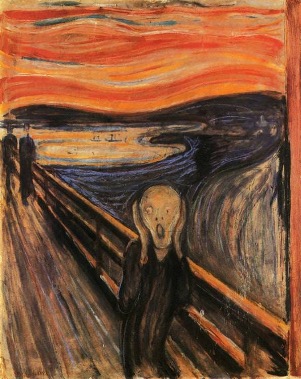
In the months that followed, volcanic ash and aerosols circled the planet, and for several years global temperatures fell by nearly 1.2°C. As ambient sunlight dimmed, crop yields more than halved. The dramatic worldwide sunsets it produced inspired Edvard Munch’s haunting painting, The Scream. Today, even as Anak [the child of] Krakatau rises threateningly within the remains of Krakatoa, we must not forget that this nearby Indonesian behemoth is still very much alive.
Don’t get me wrong, I am not predicting any sudden earthquake or volcanic activity in our immediate region—even though our own Western District is a young, still-active volcanic region. However, a major volcanic eruption anywhere in the world, especially another Krakatoa in volcanic Indonesia or volatile New Zealand, could prove very problematic for a nation dependent on sunlight for energy.
As historical perspectives matter—whether in a cub reporter’s approach to localised events or in interpreting apparent changes in global weather patterns—it may be wise to caution against a blinkered vogue for political short-termism and to keep an eye on the long game. Geo-time is measured in millennia, epochs, and eras, and is at the mercy of an unpredictable fuse.
John Agar
Feature Writer
A word from the chairman
Hello
Whilst the Chairman of Committee for Lorne, John Higgins and his wife are carousing around Europe it falls to the rest of the Committee to produce his weekly column. Cheers John!
Last weekend Lorne competed against Colac Imperials at Stribling Reserve. All football teams from Under 12 to Seniors were successful – a great result. In relation to the Seniors win, Casey Tutungi who is assisting Coach Ed Curnow said, “A great win. Sets our season up, really”. Our Netball teams did not fare as well but there were some brave tussles.
On Saturday the teams travel to Elliminyt Recreation Reserve to take on South Colac. Good luck to all!
Saturday is ANZAC Day and, as usual, there will be a Dawn Service at ANZAC Memorial Park at 7 am, to be followed by Gunfire Breakfast, organised by Lorne Men’s Shed, in the grounds of the Bowls Club. The march to ANZAC Memorial Park from Lorne Community Connect will take place at 10.45am followed by the formal service and laying of wreaths at 11am. Each year the number of people attending services on ANZAC Day continues to grow. We hope to see you there.
Another ANZAC tradition in Lorne is displaying the photographs of those Lorne people who have served in various conflicts, on the windows at Lorne Foodworks. Thanks to Foodworks for allowing this tradition to continue and a big thank you to Wendy Jarratt and John Ford who ,on behalf of the Lorne Historical Society, arrange the display. Much appreciated. As you are leaving the checkout, you will see one of the posters contains two QR codes. Scanning these codes will take you to the website of the Lorne Historical Society, to pages containing more information on the story of ANZAC Memorial Park and the Avenue of Honour.
The new Avenue of Honour, located in Smith St outside the School, was a School project and is the work of four students who conceptualised the re-modelled Avenue and planned its installation. It was officially opened by our Federal Member Dan Tehan, in November last year. If you haven’t been for a look, it’s well worth your time particularly as we remember those who served and sacrificed.
This week we have started to experience Lorne as it enters its “quiet time”. Summer has gone, school holidays are over, and whilst the weather is still mild, there has been portents of things to come as we brace ourselves for Winter in Lorne. The summer season was not the best on record for our business community in Lorne, affected by alarmist media reporting of nearby fire and floods in January. There is now a promotion to encourage people to visit and stay in Lorne with weekly prizes. This promotion is available between April 16 and June 26, 2026. Now is the time to support local businesses and encourage friend and family to visit. You can read more about the promotion here – www.lovelorne.com.au.
On behalf of our chairman,
Cheers
Pete Spring
Lorne Ward Events Calendar
May
2 Lorne Dolphins Football and Netball V Otway Districts, at Stribling Reserve, juniors match from 8:45am, seniors at 2pm
2 Great Ocean & Otway Classic Ride www.greatoceanotwayclassic.com.au
16-17 Great Ocean Road Running Festival, Running, music, wellness, adventure.
23 Lorne Dolphins Football and Netball V Alvie, at Stribling Reserve, juniors match from 8:45am, seniors at 2pm
Share


Related Articles
Liberals defend safety of 110kmh freeway plan
The Liberals have dismissed concerns their proposed 110kmh speed limit…
Teachers walk off the job for second time as AEU pushes government for deal
Victorian public school teachers will strike for the second time…