Committee for Lorne: Surfing a Tsunami wave … really?


Surfing a Tsunami wave … really?
On July 30th, 2025, a magnitude 8.8 earthquake struck just off the east coast of Kamchatka [Russia]. Equivalent in Richter magnitude to the 1906 Ecuador/Colombia and 2010 Chile quakes, it ranks equal sixth among the most severe since modern seismometers were introduced in the late 1800s.
As warnings of a catastrophic tsunami sounded around the Pacific rim and more than two million people were evacuated to higher ground, big wave hopefuls waxed their boards and watched from the headlands for the approaching wave[s] … a macabre example of one man’s tragedy being another man’s opportunity!
However, the waves never came, and within 24 hours, emergency measures were downgraded, people returned home, and the disappointed surfers put their board wax away and went back to the pub. Only one indirect fatality and 21 injuries resulted—all related to the evacuations, and all in Japan.
Given the catastrophic outcome of the 2004 Indian Ocean earthquake [230,000 deaths] and the 2011 Fukushima disaster [19,300 deaths], one can’t blame the authorities for erring on the side of caution. But a lesser yet interesting side question has been debated: can a surfer ride a tsunami wave, as some have claimed?
Wave ‘anatomy’ is straightforward, as all waves—water, sound, electrical energy, or light—use the same terminology and conform to the same general sine wave pattern. Basic wave criteria include: wavelength, speed, and height [in surfing, a matter of heated debate], with frequency [the number over a given time], periodicity [the gap between waves], and total energy completing the mix. With ocean waves, there are two main creative forces: surface wind and a disturbance at the ocean floor, where massive volumes of water suddenly upwell after an undersea earthquake or volcanic eruption.
While some brave [or foolhardy] surfers enjoy riding massive waves for the adrenaline rush [and kudos] they bring, these are not tsunami waves but wind-blown waves that have been magnified by geological quirks. The most famous example is Praia do Norte [Nazaré, Portugal], where an undersea canyon funnels, amplifies, then throws seasonal Atlantic swells against a coastline so shaped that it reflects the waves back against each other to form a peak of astonishing size. As luck would have it, the peak offers left and right ‘escape’ shoulders [off-ramps] to permit safe exit. Huge … yes, but a tsunami wave … no.
As an author-paraphrased New Zealand government website [https://tinyurl.com/4cf9cwkd] explains: “… for a surfer to ride a wave, the wave must have a ‘face,’ but tsunami waves, with their long wavelengths, immense energy, astounding speed, and vast volumes of water, are fundamentally different, lack a ‘face’, and are not surfable. Attempting to do so would be extremely dangerous. Tsunami waves travel at incredible speeds in the open ocean [up to 800 km/h and as fast as a jet plane], and though they slow as they reach shallower coastal waters due to the rubble, mud, and organic ocean detritus they push before them.”
One surfing blog site [https://tinyurl.com/55zuv7pm] accords the world record for the fastest speed on a surfboard to Josh Enslin [81 km/h in 2017], which surpassed the previous record set by Layne Beachley [78.26 km/h]. The fastest wave ever surfed was recorded at 62.3 km/h [Note: as a surfer traverses the face of an incoming wave, the traversing speed is added to direct forward speed—hence the discrepancy].
One “I surfed a tsunami” story that holds credence is that of big wave rider, Felipe Pomars, a legendary Peruvian who, with a 1965 World Surf Championship podium win and a series of podium finishes in the Duke Kahanamoku Invitational, deserves significant respect for his story. In October 1974, he records that he ‘rode’ a tsunami wave, though his ride was more a chance battle for survival than one of ‘whoopee, what fun’ intent. Felipe’s tale in Wavelength magazine [https://tinyurl.com/3tmy2hu2] is a heady mix of personal heroism and a whole lot of luck.
While a handful of surfers have made less certain claims, Felipe’s surf-to-survive experience is the most credible. As for the “Oh, goodie, here comes a tsunami … let’s paddle out” idea, it is not smart thinking. Rather, it should always be: “Tsunami Alert? … quit dreaming, head for the hills [literally], and let the board fend for itself!”
So … why are wind-generated and tsunami waves so different? Comparing the two:
- Wind-generated waves have a relatively short wavelength [metres] and a short inter-wave periodicity [seconds]. In contrast, tsunami waves have extremely long wavelengths [hundreds of kilometres] and long inter-wave periodicities [minutes to hours].
- The wave energy of wind-generated surf is concentrated near the surface and is relatively localised, while, in contrast, tsunami waves affect the entire water column from the seafloor to the surface.
- Wind-generated waves travel at speeds from a few km/hr to tens of km/hr and have a localised shore impact, while in the deeper ocean, tsunami speeds rival those of a jet plane. As they begin to slow down near the coast, their energy is transferred into a massive water surge capable of flooding coastal areas and extending far inland.
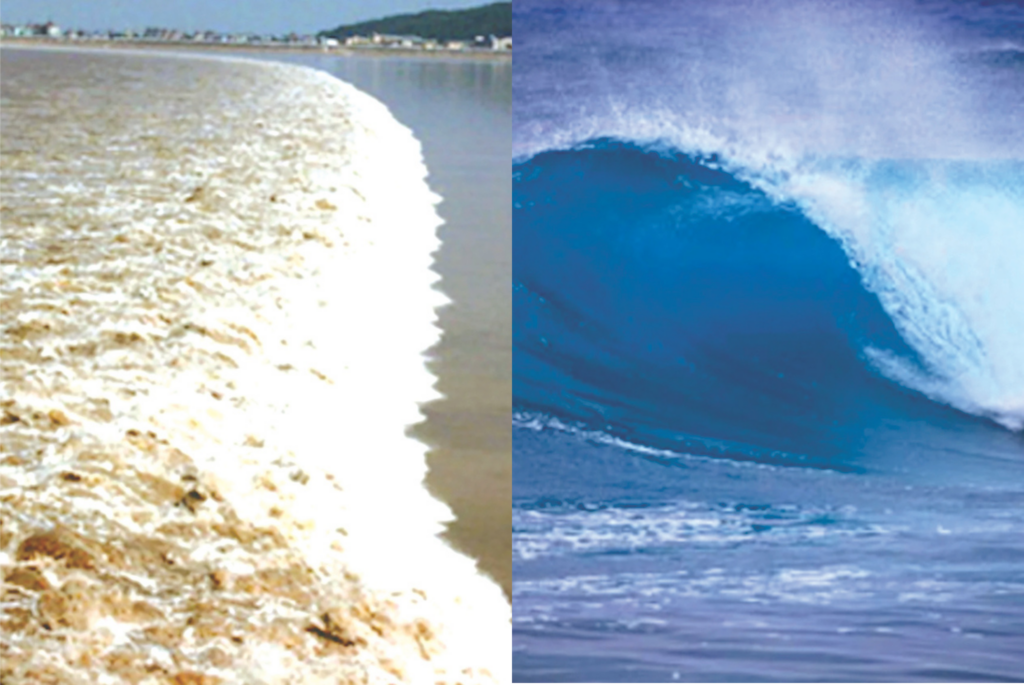
- Wind-generated waves ‘hold’ a sloping green-water ‘face’ that surfers can ride. Conversely, tsunamis lack a defined face or peak and arrive as a rumbling, tumbling wall of white-water and debris with such force and remaining speed that to try to surf it would be [a] impossible and [b] extremely dangerous … see photographs.
- One characteristic that both wave forms share is the ‘shoaling’ effect—the increase in wave height that occurs as a wave passes from deep to shallower water … just watch the swells build in height as they march in over Louttit Bay, slow, rear, and break at the shore. Tsunami shoaling is far more insidious, however, where a wave of less than one metre amplitude in mid-ocean can shoal to greater than 30 metres [Lituya Bay, Alaska, 1958] at the shoreline.
Waves can reflect, refract, or diffract when two or more waves interfere with each other. This can often be seen in the conflicting wash of a rip, or in miniature at the mouth of the George River when, after heavy rain, a tidal surge meets the fast-flowing downstream current. As the opposing wave forces crash against each other, super-peaks or standing [stationary] waves can appear.
Standing waves are artificially created for thrill-seekers at landlocked wave parks [Urbnsurf Melbourne: https://tinyurl.com/2zvmaxs5], if two waves of the same frequency are directed against each other from opposite directions. The best-known standing waves in nature are the Eisbach River in Germany, the Waimea River Mouth in Hawaii, and Aliso Creek in California.
So … you want to surf a tsunami wave … really?
Surfers, forget it! The next time you hear a tsunami warning, put your wax away and head to the hills with everyone else!
John Agar
Feature Writer
A word from the chairman
Hello
Community is a word that is often used, but what does it mean? There are many dictionary definitions, but I think the one that best describes the Lorne community is “a group of people who share a story that is so important to them that it defines an aspect of who they are”.
We are not unique in Lorne, but we are “special” in the community we have. You can see it reflected around us in the facilities we have, the Stribling Reserve Community Pavilion, Lorne Community Connect, our school, our hospital, medical centre and nursing home, our three churches.
But our community is much more than facilities, it is about the coming together of Lorne people in times of sadness and joy, of need and celebration. We have seen it this year with the commemoration of the lives of those who have passed on, the support of our netball, football and cricket teams, the many community organisations that support our town. And in so many other ways.
Community also brings people power as we have seen this year in relation to the Point Grey redevelopment, culminating in the recent public meeting which clearly and unequivocally expressed the community’s wishes for this special place. We are making some progress on this and hope to report further to you soon.
At this time of year, our community comes together to celebrate the spirit of Christmas. Last weekend, Lorne Community Connect held it’s Christmas Market which brought many of our community together to share their art, craft and company. A highlight was the performance by the 35-person community choir who entertained us with an eclectic mixture of songs. It was a delight to see the happy facial expressions as they surrendered themselves to the music. If you missed them, don’t worry, they will be performing again at Carols on the Lorne at St Cuthberts Church on Saturday 20 December from 6.30pm. Congratulations to the organisers of the market which I am sure will become an annual event.
Just a reminder too that Santa will be at the Lorne Visitor Information Centre from 10 am to 1pm on Saturday 13 December for photos and face-painting.
Congratulations to the Costa family for once again lighting up North Lorne. Their display gets better every year and brings joy to many, not just children. Santa won’t miss Lorne this year, let’s just hope he makes it past North Lorne!
The community-funded New Year’s Eve fireworks are happening again this year with two displays, at 9.30pm (for the very young and very old) and midnight for those celebrating the ticking over of the calendar. Once again, this year we have secured substantial donations from local businesses and community organisations, but we also need your support. We have received substantial individual donations, but we need a bit more. Please consider a donation through GoFundMe if you can, and you will know that you have contributed to a display that brings joy and wonderment to people of all ages. You can contribute at https://www.gofundme.com/f/lorne-fireworks-new-years-eve-2025
Cheers
Lorne Ward Events Calendar
December
13 Take a photo with Santa, at Lorne Visitor Info Centre Kids Face Painting 10am-1pm
14 Deans Marsh Market, at Deans Marsh Reserve 4.30pm-8.30pm
14 Music at the Marsh, Christmas Edition 4.30pm – 8.30pm
20 Carols Lorne, St Cuthberts Church – 6.30pm Sausage sizzle 7.30pm Carols
Share


Related Articles
Neighbourhood Watch calls for Armstrong Creek police station
ARMSTRONG Creek’s Neighbourhood Watch believes the growth area is big…
The printer that could transform home building
TWO social housing homes in Norlane have had their walls…