Committee for Lorne: The George



The George
I remember a phrase my mother used, now and then, to explain—or not—the vicissitudes of the natural world.
“Nature is as nature does”, she would say with a wise nod, as if all the wisdom of the world was cradled within.
I never gave it a whole lot of thought at the time—it seemed a trifle deep for a young boy besotted with tossing and catching his football—and I confess to putting it aside.
At the George, today, five weeks ‘post-deluge’, that phrase suddenly came back to me … with a vengeance. I suddenly had a deep sense of her meaning.
Back when the world was Google-less, the closest I had to an independent resource was a complete set of Encyclopaedia Britannica, but it performed poorly with phraseology. Words, yes: phrases, no.
Could it be Shakespearean, I wondered. However, although Shakespeare invented over 1,700 new English language words and sayings that are still in common use, including such phrasing gems as “one fell swoop,” “in a pickle,” “good riddance,” “heart of gold,” and “wild-goose chase”, “nature is as nature does” does not appear to be one of his. So, I googled, and while it wasn’t very helpful regarding a likely ‘origin’, Google did have a bit to say about the phrase itself.
As any Google search now seems to begin with an AI summary—a trend I find annoying, as I prefer, enjoy, and learn far more from performing my own sift of the sources [herewith a spoiler alert for our young], something made me read this one. Quite surprised, I rather liked it! It read as follows:
“The phrase—nature is as nature does—emphasises that the essence of any entity, whether a living organism, ecological system, or human, is defined by its actions, behaviour, and inherent character rather than just its appearance. It signifies that nature acts according to its own laws, encompassing chaos, growth, and survival”.
Gee, I thought, that’s a bit turgid, but getting the gist, I read on …
• A thing’s “nature” is understood through how it acts, reacts, and unfolds.
• The phrase implies that nature is not static but is a dynamic, living process and suggests that everything, from a storm to a human, operates according to its fundamental, inherent nature.
Here, the AI summary started to stray off pisté, so I will spare you the rest, but I reckon you’ll be getting the gist, too.
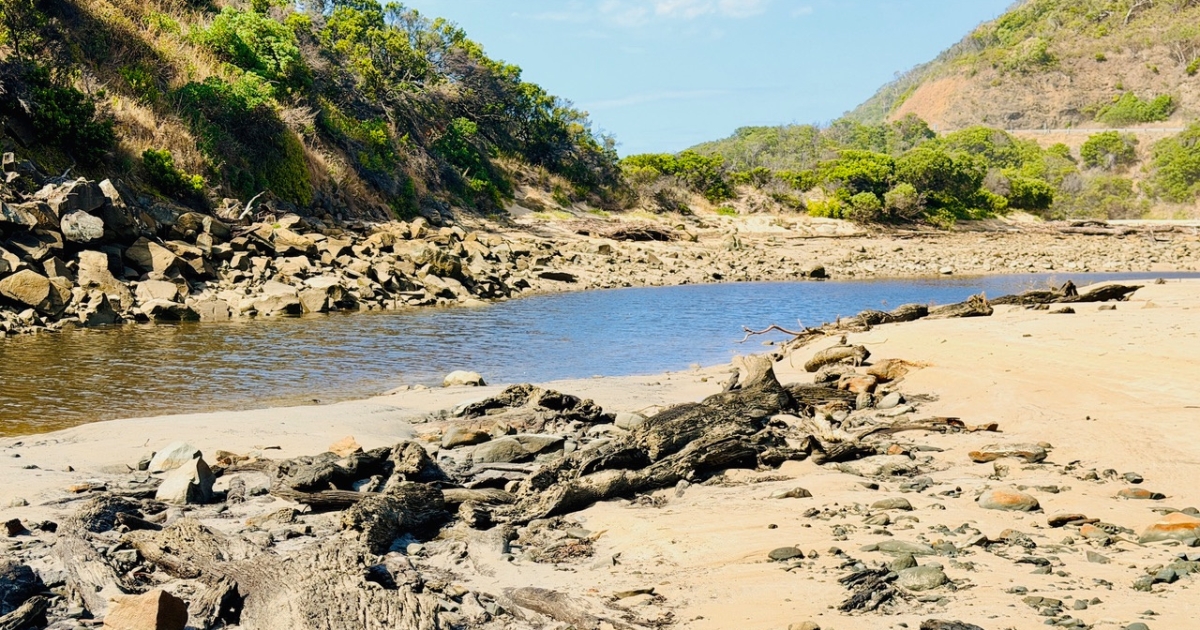
Driving around the coast to the Kennett and back, the marks left from the beating that nature recently handed out to itself still lay heavily on the eight river beds and estuaries that had borne the brunt of January’s flood. Although the smashed cars and vans had long gone, the physical changes to the estuaries remained and will inevitably take a far longer time to heal.
However, one river bed stands out as the most severely devastated, the most architecturally altered … the St. George [locally simply known as ‘the George’]. Although the damage to infrastructure, possessions, and equipment—the dollar value and the heartache of loss—is more evident along the banks of the Cumberland and the Wye, the gouging change to the river bed and banks of the George seems at another level—at least as far as can be seen from the GOR—though as access to many of the walking tracks has been temporarily blocked by GORCAPA to permit ‘repairs’, it is possible that equal or worse scouring may be present further up the other rivers but currently out of view.
Perhaps the damage appears all the more shocking and impactful because the George is so close to Lorne, is a favourite spot for walking our dogs off-leash, and is a cherished and safe summer refuge for young families seeking to escape the cabana-covered mayhem of the main beach.
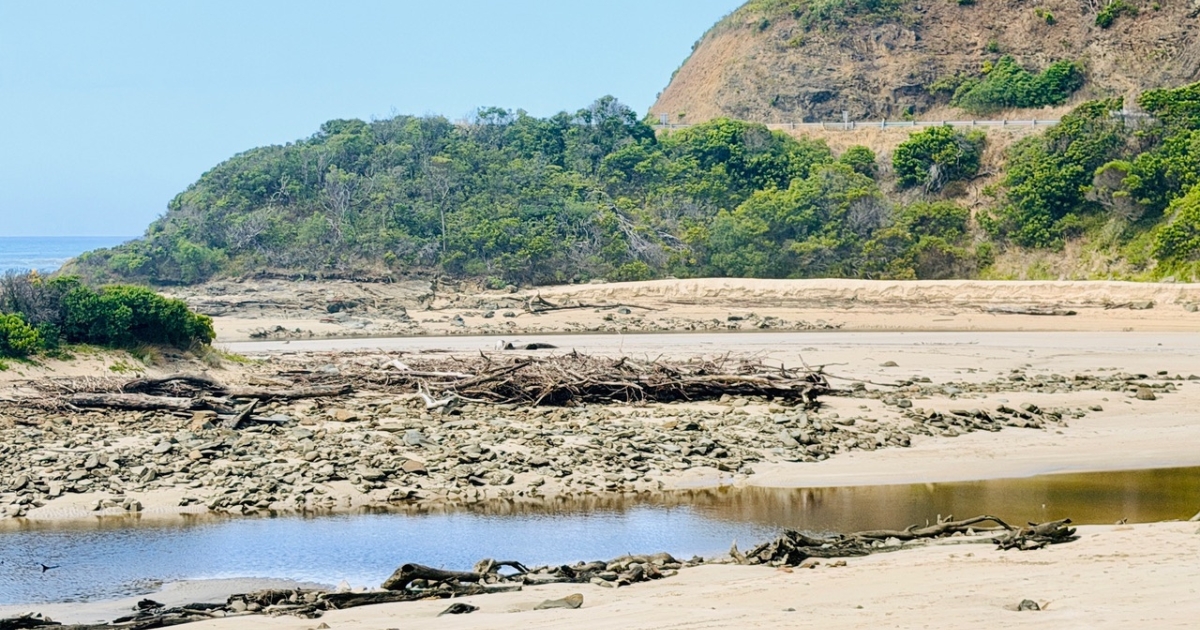
Suddenly, gone is the shallow stream that, for generations, has meandered through an expansive golden sandbar and provided local parents with a safe place to teach their children water safety, though the narrow seaward inlet is not a surf-safe spot and has a tricky rip on an outgoing tide that demands care and respect. Now, storm-washed tree trunks and debris lie everywhere, while its broad, tempting sandbanks have been washed clear away. Little remains but rubble, rocks, and a jumble of driftwood.
No doubt it will heal in time—indeed, there are signs that it already may be—but it is still hard to imagine how, or what form that repair may take. Hopefully, the always higher winter tides and stronger winter water flows in the river will combine to slowly float and wash the smaller branches, logs and debris out to sea. But, as I stood on the George’s damaged banks a week or so after the flood and watched the heavy lifting equipment that had been brought in to clear the Wye and Cumberland of their debris roll on past on the way back to Geelong, I couldn’t help wondering why they weren’t stopping here, too. One day’s work would have done it. Just one day … but then, just like the trucks, the moment passed.
Unlike the rest, the George appears to have been left to fend for itself.
Nature will eventually reshape this once-idyllic spot—of that we can be certain. But without some help to clear the heavy debris, it will take a long time. I can only regret an opportunity lost as those trucks rolled on by. Meanwhile, Lorne has lost one of its natural gems.
With Point Grey, Vera Lynn, and Rosie’s seat off-limits, access to the pier complex is restricted, and with many local walking tracks and bush picnic spots also closed, the coincidental loss of the George will be deeply felt by our small community. Had Lorne still been locally managed—as it once was—things may have been different, but now ‘managed’ from afar by ‘managers’ who lack local nuance or knowledge, such sensitivities have been lost
As Lorne has taken quite a few gut punches lately, it’s hard not to wonder what may come our way next.
John Agar
Feature Writer
A word from the chairman
Hello,
Someone once said, “If you remember the 70s you weren’t there!”. While this may resonate with many who were “there” in the 70s, many of those same people are now facing the real 70s and the challenges and opportunities that brings. We are fortunate that with advances in medicine and technology, most of us can expect to live longer than our parents. However, we cannot and must not take that for granted as many new and unexpected medical conditions can change our life plans very quickly. We all know of friends who have quickly declined from fit and active people to be confronted with life-threatening and life-ending conditions. While this may seem a morbid topic for this column, my point is to stress the importance of making the most of every day, doing what you want to do rather than what you feel obligated to do: to travel, to socialise, to read, to sing, to swim or just to be still. Make these 70s memorable!
We are especially fortunate that being in your seventies in Lorne (one of the world’s “Blue” zones, but don’t tell everyone!) is not a ticket to the retirement home or the “lifestyle community” as some are quaintly called. No, the septuagenarians of Lorne are bike riders, Mermaids, golfers and bowlers, as well as the backbone of many of our community organisations including the Op Shop, the Aquatic Club and the Men’s Shed.
As we say farewell to summer (officially) for another year, we look back on a season which was different in many ways. It was not a great summer weatherwise, with some extremely hot days and some unseasonally cold days (some people had an open fire on Christmas Day!). We lived with the threat of bushfires which fortunately did not eventuate to impact Lorne, although many of our neighbouring towns suffered greatly, and we lived through the riverine flood which caused relatively minor damage in Lorne but devastated nearby communities. Unfortunately, the media reporting of these events deterred visitors from coming to Lorne and severely impacted our local businesses for several weeks, however more positive and accurate publicity has seen the return of visitors in numbers and smiles back on our traders’ faces.
The Point Grey redevelopment continues apace with site preparation well underway. There have been some unfortunate and inconsiderate hygiene and parking issues which have impacted local traders, residents and beach users. GORCAPA has responded promptly when these issues were brought to their attention, with the installation of temporary toilets and an undertaking to continue to monitor the situation and to continue to liaise with affected parties.
Our cricketers had a comfortable five wicket win last Saturday against Colac in their last home and away game. They have finished the season in third place and now face a must-win final against Tomahawk Creek to stay in the running. The game will be at Birregurra starting at noon this Saturday and our players look forward to your support. Good luck boys!
Cheers
John
Lorne Ward Events Calendar
March
7 Lorne Market, 9-3pm www.lornemarkets.com/
8 Fishing Comp No. 2, Weigh-in cut off 12.30pm. Free roast lunch for competitors, presentations will all be held at Stribling Reserve downstairs.
22 Deans Marsh Festival, Live music, local harvest, market stalls, dog jumping, kids events and much more. 10am – 3pm at Deans Marsh Reserve.
Share


Related Articles

Neighbourhood Watch calls for Armstrong Creek police station
ARMSTRONG Creek’s Neighbourhood Watch believes the growth area is big…
The printer that could transform home building
TWO social housing homes in Norlane have had their walls…