Committee for Lorne: Whales – again!


As some readers may know, I submit articles for publication in both the Surf Coast Times and the Lorne Independent. The themes are almost always my own choosing, and—where possible—I avoid cross-pollination between the two journals. I also try to avoid repeating the same subject matter.
However, given that our coastal resident population changes over time, some topics warrant an occasional reprise, and our annual pastime of whale watching is one of them.
For those who remember my past dips into this subject … [1] ‘Whales are on their way’ [Lorne Independent: 7/2022] and [2] ‘The Mighty Orca’ [The Surf Coast Times: January 2023], when an orca pod made a non-seasonal and unexpected appearance [admittedly, orcas are not whales at all, but the largest of the dolphin family] … please forgive the repetition. The following article is a revision of the Lorne Independent article from June 2022.
For those new to our whale season, or who are simply passing us by in our winter months, it is time to begin scanning the horizon. The whales are—or should be—coming! Astute GOR travellers may soon notice knots of hardy people, dressed warmly against the biting Antarctic wind, gazing out to sea in rapt expectation, with binoculars, cameras, and smartphones at the ready. They will likely be watching whales, dolphins, or diving gannets—and sometimes all three—and the show can be quite exhilarating.
If anyone is seeking additional information, try Googling some of the existing Bass Strait whale-watching sites:
- https://www.swifft.net.au/whaleface/
- https://www.facebook.com/GreatOceanRoadWhales/
- https://visitgreatoceanroad.org.au/whale-watching/
These sites are all worth checking and provide helpful information, though some rely on volunteer input and can thus lag behind [or occasionally be at the forefront] of current sightings. The One and Only Lorne Facebook page can generally be relied upon to post whale sightings in real time.
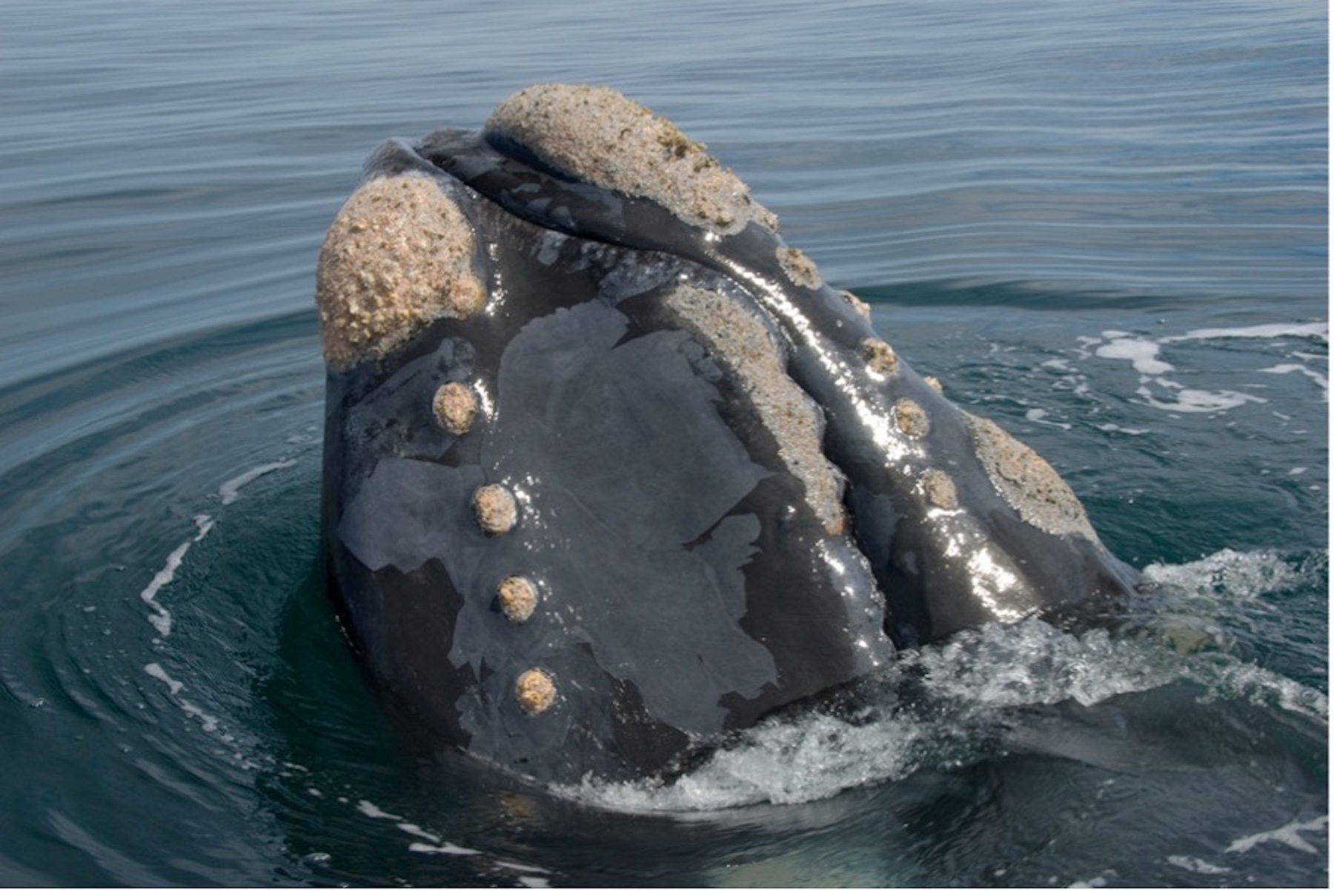
My favourite is the Swifftnet ‘WhaleFace’ website [note: Swifft has two ‘ff’s] because it takes a scientific approach and documents individual whales by their callosity patterns. As the site notes: ‘… we call this project WhaleFace because it is the unique patterns of white features (called callosities) on the Southern Right Whale’s head that help us identify and follow individual whales.’
A Canadian website https://baleinesendirect.org/ describes the appearance of callosities as follows:
‘… they are found at the end of the rostrum [the ‘beak’ or ‘snout’ of a whale], on the lower lips and chin, above the eyes and in front of and behind the blowhole. Callosities are peculiar to the ‘right whales’ … [NB: the Southern Right Whale is the most frequently seen whale around our coast]. Callosities are congenital ‘growths’, are already present in the foetus and at various prenatal stages, and are not caused by the external environment.’
Again, quoting from the same website:
‘… callosities are irregular patches of thickened and keratinised tissues and are a habitat for three species of amphipod crustaceans that specialise in right whales. Two of these crustaceans, Cyamis ovalis and Cyamis gracilis, are white and are found on normal callosities in healthy individuals. The third, Cyamis erraticus, is orange and is only found in the wounds of sick or very young whales. These small crustaceans [also called whale lice or cyamids] feed on the whales’ skin and travel from one whale to another by direct contact. They appear to do the whale no harm.’
One bonus of these unique and distinctive markings is that, of all whales, they act as ideal ‘fingerprints’, allowing every whale to be identifiable. Individual Southern Right Whales are often allocated a name, are looked for, spotted, and welcomed back each season by that name.
Many coastal whale-ophiles have come to ‘adopt’ individual whales: ‘… look, there is ‘xxxxxx’ … my whale!’ as xxxxxx reappears, season after season. Conversely, if xxxxxx is not spotted, its absence can be emotionally disturbing with: ‘… I wonder if he/she is OK?’ — or: ‘… I hope something has not happened to him/her’.
WhaleFace, with help and encouragement from DELWP [the Department of the Environment, Land, Water and Planning], is chock-full of information about whales. If you want to learn more about the Southern Right Whale, you need to go no further than: https://www.swifft.net.au/cb_pages/team_southern_right_whale_south_eastern_australia_monitoring.php.
Two questions are often asked about our two dominant whale species along the eastern seaboard of Australia—the Humpback Whale and the Southern Right Whale.
- Why is the Southern Right whale called a ‘right’ whale?
The Australian Museum states that: “… the Southern Right Whale was once abundant in the waters of southern Australia, but numbers were drastically reduced during intensive whaling in the 1800s. It was called the ‘right whale’ as it was regarded as the right whale to catch because of its meat and high oil content.”
- What is the difference between a ‘right’ whale and a humpback whale?
A Southern Right whale does not have a dorsal fin on its back and is unique in that it will always ‘wear’ a distinctive pattern of callosities. It is the only whale that does. On the other hand, a Humpback has a small dorsal fin and long pectoral flippers, and they just love to show off their tail flukes. Both are similar in size and weight, with adults of both species averaging 12-16m in length and weighing 40-50 tonnes. Both species are seasonally present in Australian waters from late April to November [Lorne: most commonly June to October] as they migrate north from their Southern Ocean feeding grounds to mate and calve in the warmer waters of Southern Queensland.
As for dolphins [and an occasional orca family], years ago we would commonly see pods numbering in the hundreds as they chased schools of Bass Strait couta across the horizon. Now that the couta have gone, large dolphin pods are rare, though lone animals or small families are quite commonly seen harmlessly enjoying the surf at our Lorne Point alongside and among our local surfers.
On the other hand, years ago we saw few, if any, whales, yet now they quite frequently meander past each winter. While I miss the dolphins, I do rejoice in the whales. Deep down, I harbour a hope that—one day—we may be regularly graced with both!
John Agar
Feature Writer
A word from the chairman
The chilly blast of this past week is a sombre reminder that the warmer weather and sunny days we have been experiencing for most of the year will soon be just a memory of the summer of ’26.
So many of our community are already experiencing the warmer weather of the northern hemisphere. Although some of the despatches back to Lorne are referring to days of extreme heat and it’s not the height of European summer yet.
No doubt more Lorneites (this author amongst them) will make the pilgrimage to the Lorne of the North, Port Douglas, as the cold weather set in.
For those of us who spend most, or all, of winter in Lorne, remember to spare a thought for those local businesses who remain open to serve our community over the coming months. The heady days of the summer season are over. Although this past summer season wasn’t all that flash for reasons of floods and fires, and that’s all the more reason to “spend local”. The businesses in Lorne provide a terrific service to us and we are very fortunate to have such variety and diversity. Most of our hospitality businesses now offer meal specials for Locals. In fact, there a sufficient of them on offer at the moment that you could eat out well for a reasonable price on every night of the week! Might be a bit of overkill , but you know what I’m getting at – your support of our local businesses over these quieter times is just one more indication of the great community in which we live.
***
The Lorne Market on the Foreshore, run by Lorne p-12 College is on this Saturday. It’s worth your while to stop by, taste some delicious feed and pick up some goodies from the wide array of stallholders.
Proceeds from the Market are used by the school to help fund projects at the school. Recent projects include the Avenue of Honour, new Adventure Playground equipment and exercise equipment. A walk along Smith St past the School will showcase all these projects. Out of school hours, the adventure playground and exercise equipment is available to the whole community. With no locked gates and fences, Lorne P-12 College truly is an integral part of our wider community. When you have a look at these features in Smith St, take a moment to consider that every project is carried out with deep involvement from the students. The result is outstanding. The students have a real sense of ownership. There are now over 200 students at Lorne P-12 College and they come from as far away as Birregurra, Winchelsea and Anglesea. Lorne P-12 College is now regarded as the school of choice in the region. When you visit the market on Saturday, say hello to the staff and volunteers at the Lorne P-12 tent. Their enthusiasm and commitment to the task is incredible. Then go for a shop around the market knowing that by supporting this venture, you are helping Lorne P-12 to be such an amazing asset in our Community.
Pete Spring
Deputy Chair, Committee for Lorne
(STILL standing in for Chairman John Higgins who is STILL swanning around in Europe. Not even a Postcard!)
Lorne Ward Events Calendar
June
7 LAAC Fishing Comp No. 4, Weigh-in cut off 12.30pm. Free roast lunch for members & competitors, presentations will all be held at Stribling Reserve downstairs.
20 Lorne Dolphins Football and Netball V Western Eagles, at Stribling Reserve, juniors match from 8:45am, seniors at 2pm
20 Deans Marsh Winter Solstice, Coming together for food, song and dance, we pause and joyfully celebrate the longest of nights. 5-9pm at Deans Marsh Hall & carpark
Share


Related Articles
Liberals defend safety of 110kmh freeway plan
The Liberals have dismissed concerns their proposed 110kmh speed limit…
Teachers walk off the job for second time as AEU pushes government for deal
Victorian public school teachers will strike for the second time…