Smoke expected as planned burns begin across Surf Coast

The smoke visible is a mix of planned burns -as seen here - private burns under CFA’s permit system, agricultural burns and smoke from wood heaters. Photo: Forest Fire Management Victoria.


SEVERAL planned burns have begun and are scheduled to begin across the Geelong region, and residents can expect to see smoke in the air in the coming weeks.
Present conditions are ideal for burning, but weather patterns may cause smoke to linger over parts of Victoria overnight and through to early morning on some days.
The smoke is a mix of planned burns, private burns under CFA’s permit system, agricultural burns and smoke from wood heaters.
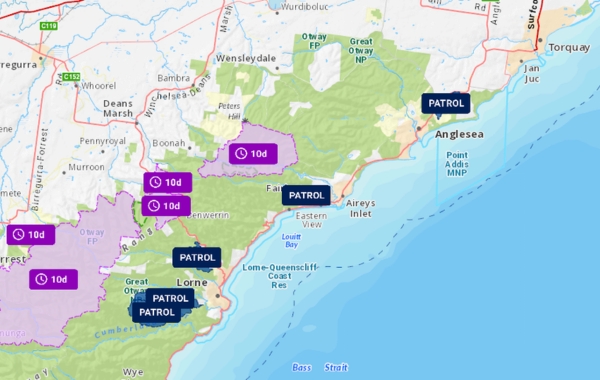
Recent fuel reduction burns in the Geelong region comprise a 19-hectare burn near Little River, a 33 hectare burn near the Ocean Grove Nature Reserve, 9 hectares of a planned 323-hectare burn near Anglesea, a 44-hectare burn near Moggs Creek, and three partially-completed burns around Lorne of 220 hectares, 186 hectares and 179 hectares respectively.
Lighting of these burns is complete and they are being patrolled, but smoke and flames may still be visible.
Other burns are scheduled to begin within 10 days, if conditions are suitable, near Little River, Bannockburn, Aireys Inlet, Lorne, Forrest, Barongarook and Gellibrand.
Forest Fire Management Victoria (FFMVic) chief fire officer Chris Hardman said it is crucial fire agencies take advantage of favourable conditions.
“Planned burning on public land is one of the tools FFMVic uses to keep Victoria safer from bushfires,” he said.
“With the current favourable weather and forest conditions this week, we are delivering as much planned burning as we can.
“Our climate is changing and that means finding the right days for safe and effective planned burning is becoming more challenging. Autumn typically provides our crews more opportunities to conduct planned burns, as the weather is more stable, and fire behaviour tends to be manageable and predictable.”
He said reducing dry vegetation such as grass, leaves, bark, shrubs and small fallen branches meant fires were less intense and slower to spread, making it more likely that firefighters could keep bushfires small and contained before they pose a risk to communities.
“We work closely with CFA, Environment Protection Authority (EPA) and Bureau of Meteorology to keep the smoke impacts from planned burns as low as possible. We make every effort to make sure favourable weather conditions reduce smoke drift into communities,” he said.
Hardman said the fire agencies recognised Anzac Day is a significant day for veterans and communities.
“We encourage everyone to plan carefully for possible smoke impacts, particularly anyone with heart or lung conditions, older people, people with diabetes, children, infants, and pregnant women,” he said.
CFA deputy chief officer Alen Slijepcevic said with fire restrictions lifting across most of the state, landholders starting to burn-off on their properties should remain vigilant before igniting their burn and ensure conditions are safe to do so.
“You may see a large amount of smoke in areas where these activities take place, so we ask farmers to let their neighbours know who may be sensitive to smoke so they can take necessary precaution,” he said.
“Any burning activity must always have someone in attendance, with enough water resources to monitor, contain and extinguish the burn safely and effectively.
“For greater awareness for emergency services and community members, burn-offs should be registered on the fire permits website or if you wish to start your burn-off immediately, register your burn-off by calling 1800 668 511.”
The Planned Burns Victoria website has details of all planned burns currently on the three-year Joint Fuel Management Program. For more information, head to plannedburns.ffm.vic.gov.au
Share


Related Articles

Boyz II Men, Salt-N-Pepa to go old school in Geelong
Old-school R&B and hip-hop has not yet come to the…
Why one Jan Juc man is riding 2,000km across WA
A prostate cancer diagnosis has inspired Jan Juc resident Marcus…