First time watching the Pro? Here’s what you need to know

Bells Beach will host the first stop of the 2026 Championship Tour. Photo: Ed Sloane/World Surf League.


IT’S the longest-running professional surf contest in the world and winning is considered a career-defining moment. This is the Rip Curl Pro at Bells Beach.
For seasoned fans, it is a highlight of the year. For others, the scoring and strategy can be harder to follow.
Why do two surfers go for the same wave? What makes a ride score a perfect 10? And how do jet skis come into play?
Here is a simple guide to what is happening in the water – and how to watch it like you know exactly what you are looking at.
The trophy:
You’ve got to win it to ring it Forget silver cups and gold medals – at Bells, it is all about the bronze Bell.
The trophy is the most recognisable in surfing, not just in look but also in sound.
On the podium, the winner steps forward, lifts the Bell and lets it ring as loud as they can. It is one of the sport’s favourite traditions.
Straight knockout, no second chances Unlike previous years, where surfers had a second chance before facing elimination, this year’s event is far more cut-throat.
For the first time, the Pro runs on a head-to-head knockout format.
Every heat is one-on-one: two surfers enter, one advances and one is out. There is no safety net, with a straight bracket determining who moves through to the final.
Waiting for the perfect wave
The Rip Curl Pro at Bells Beach runs to 11 April, but do not expect action every day.
The event operates within a waiting period – a flexible window that allows organisers to pick the best possible surf. If the waves aren’t good enough, competition pauses.
Surfing can be “on”, “off” or “on hold”. The call is made each morning at 7am.
It is all about patience and waiting for Bells to deliver its best.
The World Surf League will announce the running schedule on its website and social media channels.
Priority: who
gets the wave Priority is used to make sure both surfers get a fair shot at the best waves during a heat.
Each heat starts with no priority. Once the first wave is caught, priority is automatically given to the surfer who did not catch the opening wave.
The surfer with priority has first choice of any wave. The other surfer can still paddle for, and catch, the same wave, but only if they do not hinder the scoring potential of the surfer with priority.
A surfer loses priority once they catch or paddle for a wave.
If both surfers catch waves back-to-back, priority goes to the one who returns to the take-off zone first.
Judging: how heats are scored
The Pro is made up of six rounds. Each round contains a series of heats where two surfers compete for the highest score.
Surfers can catch as many waves as they like, but only their best two count.
Each wave is scored out of 10 by a panel of five judges, with a surfer’s best two waves combined for a maximum heat score of 20.
For every ride, the highest and lowest judge scores are dropped, and the remaining three are averaged to produce the final score.
When scoring a wave, judges assess the level of difficulty and commitment, the variety and combination of manoeuvres, and how well the surfer maintains speed, power and flow throughout the ride.
A surfer will receive an interference penalty if they interfere with someone who has priority. This usually means their final score will be reduced to just their best wave.
Ski assist: no paddle required
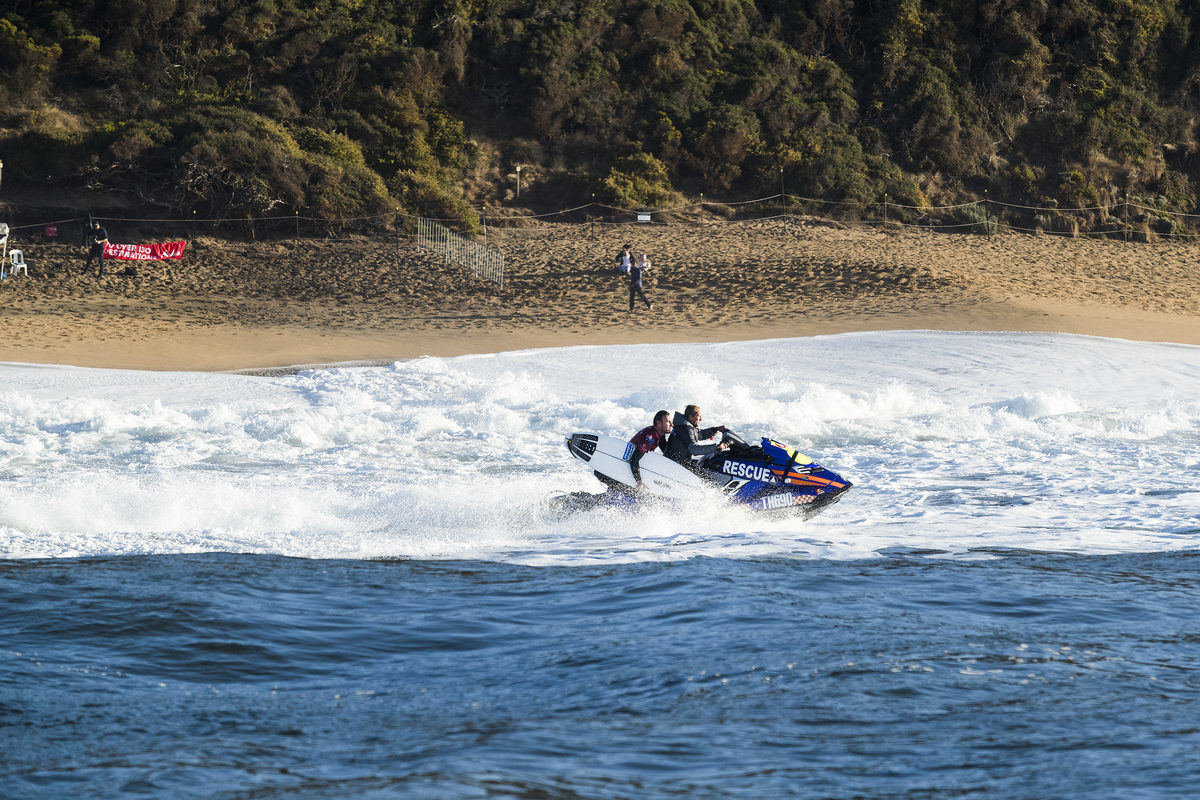
Jet skis play a key role in keeping heats moving at Bells Beach, allowing surfers to spend more time riding waves and less time paddling.
When conditions allow, competitors use ski assist to get back to the take-off zone quickly.
This means surfers have the opportunity to catch more waves in each heat.
Season opener: everything to ride for
The Rip Curl Pro at Bells Beach marks the start of the World Surf League’s 2026 Championship Tour, meaning no points have been earned yet.
There is no buffer and no rankings for surfers to fall back on – just a clean slate.
Championship points are awarded based on finishing position. The better a surfer performs, the more points they get.
Share


Related Articles
Swell – Special Feature
[...]Read More...
Artist collaboration drives new Bells look
RIP Curl has partnered with Melbourne artist Amy Jean to…